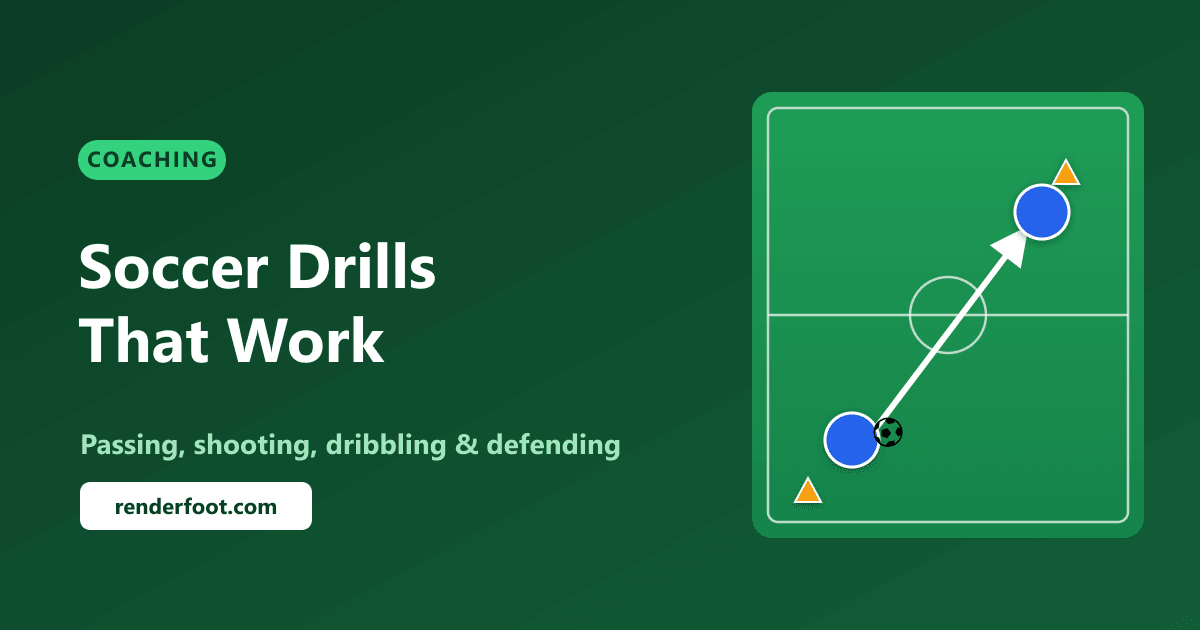
The best soccer drills target the four core areas of the game: dribbling, passing, shooting, and conditioning. A good practice session works through all four with simple, repeatable drills that give every player lots of touches on the ball. Below are 12 of the most effective drills — each with a clear diagram, the exact setup, and how to run it — plus drill ideas for kids, beginners, and solo practice.
Want to design your own session? Build and share a full practice plan with the free RenderFoot drill planner — drag cones, players and arrows onto a pitch and export it for your team.
How to structure a soccer practice
A balanced 60–75 minute session usually follows this flow:
- Warm-up (10 min) — light dribbling and dynamic stretches.
- Technical drills (20 min) — dribbling and passing in small grids.
- Skill focus (15 min) — shooting or defending.
- Small-sided game (15–20 min) — apply the skills in a real game (3v3 to 7v7).
- Cool-down (5 min).
Keep every player active — avoid long lines where kids stand and wait. The drills below are built for maximum touches per minute.
Dribbling drills
Dribbling is the foundation of ball control. These drills build close control, both feet, and confidence under pressure. For the full set, see our guide to soccer dribbling drills.
1. Cone slalom
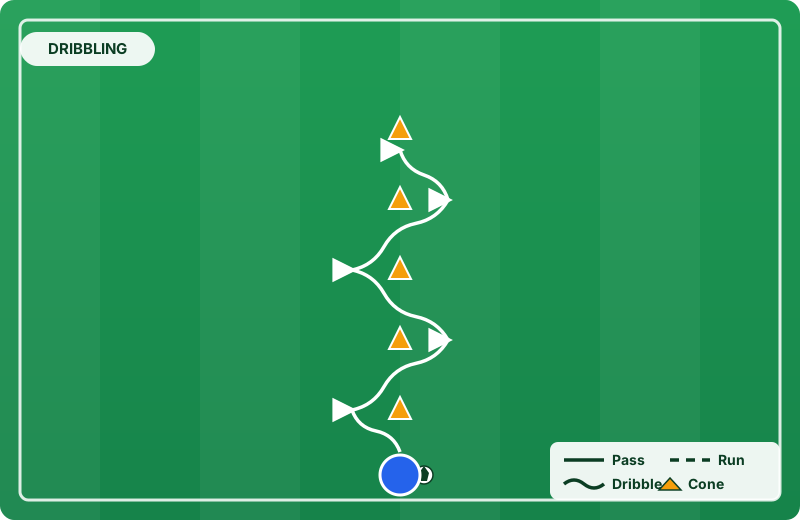
Set up 5–6 cones in a line, about 1.5 yards apart. Players dribble through the slalom using small touches, weaving in and out of each cone.
- Coaching points: use both feet, keep the ball close (a touch every step), head up between cones.
- Progression: inside-foot touches only → outside-foot only → alternating → add a time challenge.
- Reps: 5–6 runs per player.
2. Dribble box (1v1)
Mark a 10 × 10 yard box. One attacker tries to dribble across the far line; one defender tries to win the ball. Rotate after each go.
- Coaching points: change of pace and direction, shield the ball, attack the defender's front foot.
- Reps: 60–90 seconds, then switch roles.
3. Dribble & turn
Players dribble to a cone 8 yards away, perform a turn (Cruyff, drag-back or inside hook), and dribble back. Great for teaching changes of direction.
Passing drills
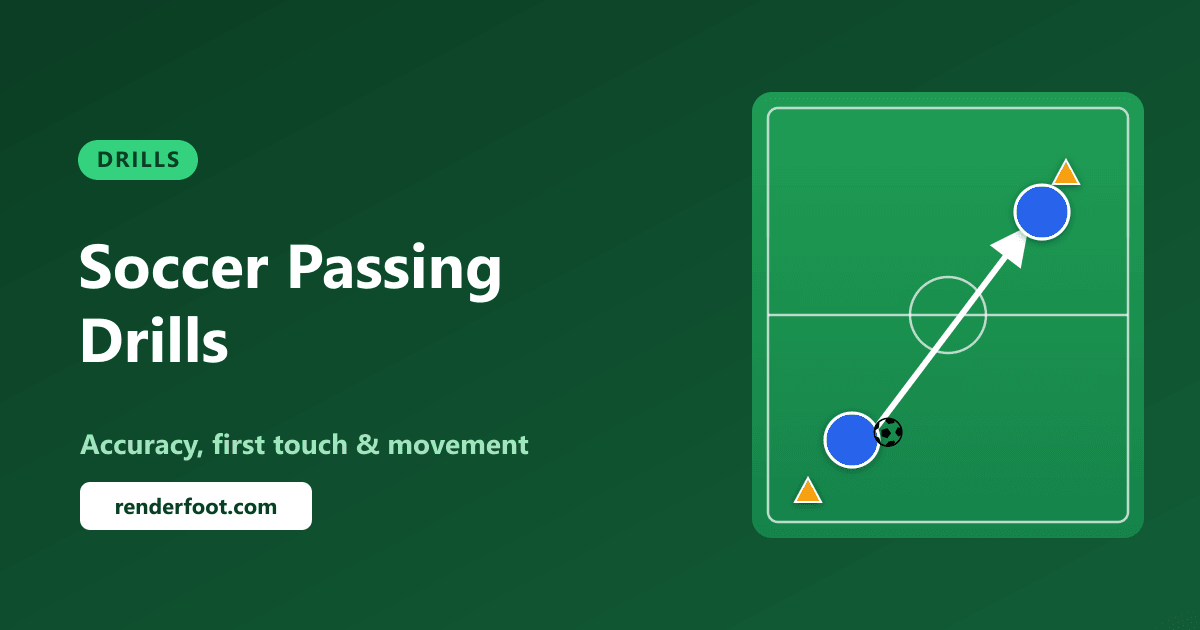
Crisp passing keeps possession and builds team play. These work first touch, accuracy, and movement off the ball. For more, see our guide to soccer passing drills.
4. Passing square
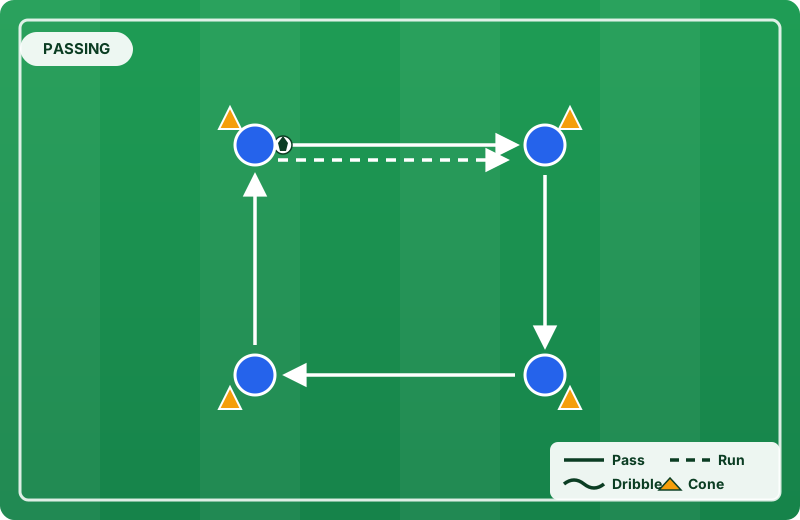
Four players, one at each corner of a 10 × 10 yard square. Pass around the circuit, then follow your pass to the next corner ("pass and move").
- Coaching points: firm, accurate passes into the back foot; first touch out of the feet; communicate.
- Progression: two-touch → one-touch → change direction on a call → add a second ball.
5. Give-and-go (wall pass)
Two players and a "wall." Player A passes to Player B and sprints forward; B returns it first time into space. Teaches the most common combination in soccer.
6. Triangle passing
Three players form a triangle 8–10 yards apart and keep the ball moving with one and two-touch passing. Add a defender in the middle for "piggy in the middle" (rondo) to add pressure.
Shooting drills
Finishing wins games. These drills build a clean striking technique and composure in front of goal. For more, see our guide to soccer shooting drills.
7. Feed & finish
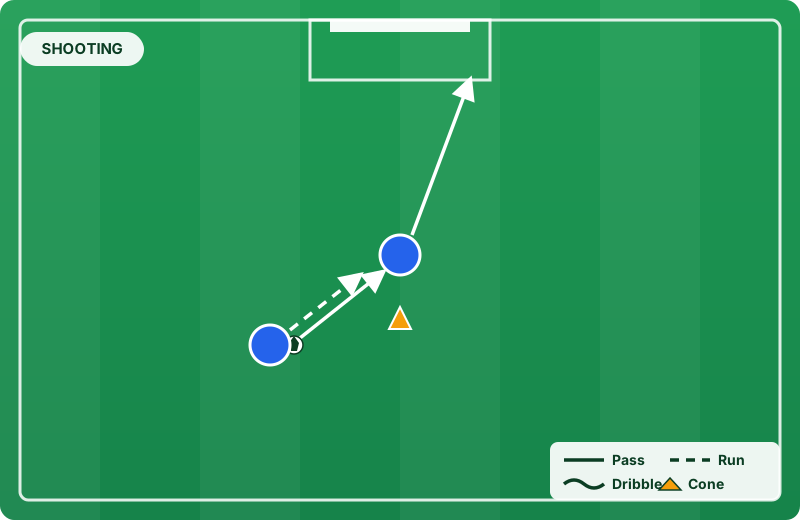
A feeder stands 8–10 yards out and plays the ball into a striker on the edge of the box. The striker takes one touch (or shoots first time) and finishes.
- Coaching points: plant foot beside the ball, strike through the middle with the laces, keep it low and on target.
- Reps: 8–10 shots, then rotate feeder and striker.
8. Shooting from the cutback
A wide player dribbles to the byline and cuts the ball back to a striker arriving at the penalty spot. Teaches finishing from a realistic crossing situation.
9. Rapid fire
Place 3–4 balls in an arc around the box. The striker shoots one, recovers, and finishes the next as fast as possible. Builds quick feet and repeatable technique.
Conditioning & agility drills
Fitness and quick feet let players perform skills late into a game. Keep the ball involved where you can.
10. Agility shuttle
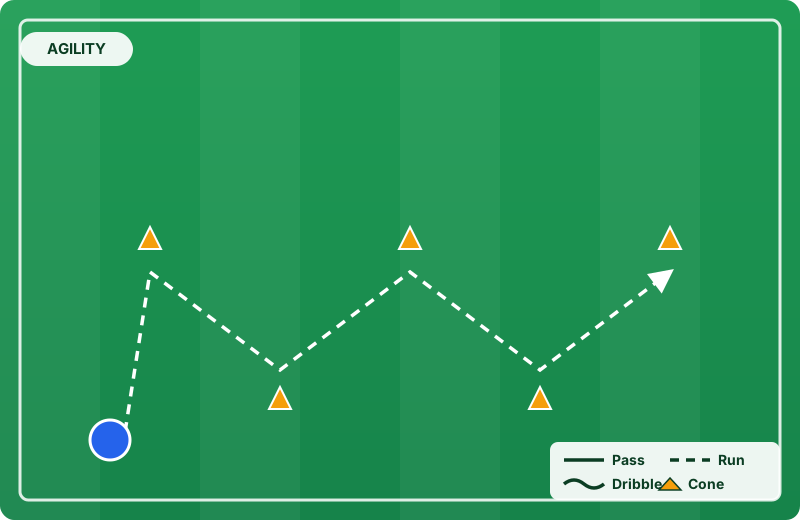
Stagger 5 cones in a zig-zag, about 5 yards apart. Players sprint and change direction around each cone, driving their arms and staying low through the turns.
- Coaching points: short, sharp steps into each turn; explode out of it.
- Progression: add a ball to dribble through the same pattern.
11. Shuttle runs
Cones at 5, 10 and 15 yards. Sprint to the first cone and back, the second and back, the third and back. Classic change-of-direction fitness.
12. Dribble relay
Split into teams for a relay race dribbling to a cone and back. Combines conditioning with ball work and adds competition — kids love it.
Defending drills
The fifth core skill is defending — jockeying an attacker, forcing them wide, and winning the ball back as a unit. It's best trained through 1v1 and 2v2 situations rather than in lines. See our full guide to soccer defending drills for the complete set with diagrams.
Soccer drills for kids and beginners
Young and new players need drills that are simple, fun, and high-touch:
- Lots of touches: every child should have a ball wherever possible — no long lines.
- Games over instructions: "sharks and minnows," "traffic lights," and tag-style dribbling games teach control without it feeling like work.
- Short and varied: rotate drills every 5–8 minutes to keep attention.
- Praise effort: confidence matters more than perfection at young ages.
For very young teams, the U.S. Soccer grassroots approach recommends small-sided games and plenty of ball contact over drilling in lines — see our guide to the best formations for small-sided football and 7v7 formations to match the drills to game day.
Solo soccer drills (practice alone)
You can sharpen most skills on your own:
- Wall passing: stand 5–8 feet from a wall and pass against it with one and two touches.
- Cone dribbling: run the slalom and dribble-box patterns above by yourself.
- Juggling: build up your record to improve touch and coordination.
- Finishing: shoot at a target in an empty goal, focusing on technique.
Turn these drills into a session
The fastest way to plan a practice is to map it out visually. Open the free RenderFoot drill planner to draw cones, players and movement arrows on a pitch, build a full session, and export it to share with players and parents — no signup required. Pair it with the lineup builder to set your game-day formation.
Frequently asked questions
What are the 5 basic skills in soccer?
The five fundamental skills are dribbling, passing, receiving (first touch), shooting, and defending. Most youth drills focus on the first four, with defending introduced through small-sided games. Mastering these basics is the goal of almost every drill above.
What are some fun soccer drills for adults?
Adults respond well to competitive, game-realistic drills: rondos (keep-away in a circle), small-sided games (4v4 to 7v7), finishing competitions like "rapid fire," and possession games with points. Keep the ball involved and add a scoreboard to drive intensity.
What are the best soccer skills to practice?
Prioritize the skills you use most in a game: first touch and passing (you do them constantly), dribbling under pressure, and finishing. Adding change of direction and acceleration rounds out a complete player. The drills above cover all of these.
How long should a soccer practice be?
For youth teams, 60–75 minutes is ideal — long enough to cover warm-up, two or three technical drills, and a small-sided game, but short enough to keep focus. Older and competitive teams may train 90 minutes.
How do I keep kids engaged in soccer drills?
Give every child a ball, use game-based drills with names and a goal ("can you beat the cones in 10 seconds?"), keep each activity under 8 minutes, and finish with a scrimmage. Standing in long lines is the fastest way to lose young players' attention.
Plan your next session
Great practices come from good planning. Coaching a youth team? We have full session plans for U8, U10 and U12. Use the free RenderFoot drill planner to design and save your sessions, and explore our tactics guides and formations guide to connect your training to game day.