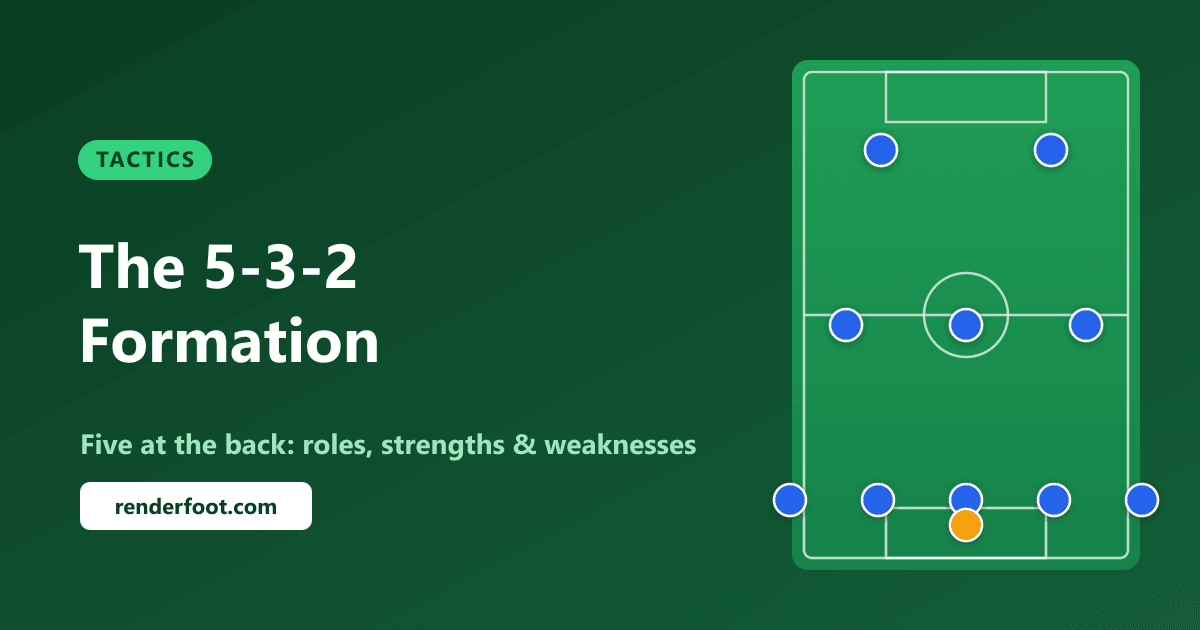
The 5-3-2 is a five-at-the-back formation with three center-backs, two wing-backs, a midfield three, and two strikers. It looks defensive on paper, but a well-coached 5-3-2 is one of the most balanced, hard-to-break-down systems in soccer — the wing-backs provide all the attacking width while five defenders smother the center.
This guide breaks down every role, the formation's real strengths and weaknesses, when to use it, and how to beat it. New to tactics? Start with our best football formations guide.
The structure
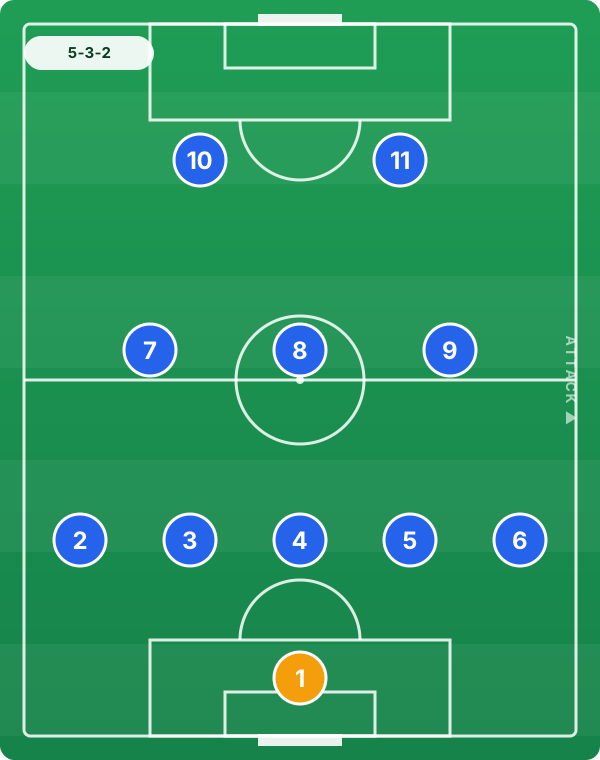
Read from defense to attack, the 5-3-2 has three bands plus the goalkeeper:
- Back five — three center-backs flanked by two wing-backs. One center-back often acts as a sweeper/spare man.
- Midfield three — usually one holding midfielder and two central midfielders.
- Two strikers — a front pair that can press together and combine in attack.
The key thing to understand: the "5" is not five out-and-out defenders sitting deep. In possession the two wing-backs push high and the shape becomes a 3-5-2, with three center-backs at the back and five across midfield. Out of possession they drop in to form the back five. The 5-3-2 and 3-5-2 are really the same system at different moments of the game.
Player roles in the 5-3-2
The three center-backs
Three central defenders give natural cover: two can mark while the third sweeps behind. This makes the 5-3-2 extremely secure against two strikers and quick balls in behind. The middle center-back is often the organizer; ball-playing ability helps the team build out from the back.
The wing-backs (the engine of the system)
The wing-backs are the most important and most demanding players in a 5-3-2. They must defend as full-backs and attack as wingers, covering the entire flank for 90 minutes. When they push up, they provide the width that lets the two strikers stay central. If your wing-backs aren't fit and disciplined, the 5-3-2 doesn't work.
The midfield three
Typically a holding midfielder screens the defense while two central midfielders link play and support the strikers. With the wing-backs providing width, the midfield three can stay narrow and dominate the center of the pitch.
The two strikers
A front pair keeps a constant attacking threat and lets the team counter quickly. The two strikers also press the opponent's center-backs together, helping to force play into wide areas where the 5-3-2 wants it.
Strengths of the 5-3-2
- Defensive solidity. Three center-backs plus a holding midfielder make the center almost impossible to play through — ideal against teams with a single striker or a strong number 10.
- Width without sacrificing the middle. Wing-backs supply width so both strikers and the midfield three can stay central and compact.
- Dangerous counter-attacks. Two strikers and overlapping wing-backs create a fast, direct counter the moment the ball is won.
- Protects a lead. Few systems are better for seeing out a result against a stronger opponent.
Weaknesses of the 5-3-2
- Wing-back dependency. If the wing-backs are pinned back, the team becomes a passive 5-3-2 with no width and the strikers get isolated.
- Fitness demands. Wing-backs covering the whole flank tire late in games, leaving gaps.
- Can be overloaded wide. A team with two wide attackers on the same side can pin a wing-back and create 2v1s.
- Strikers outnumbered in build-up. Against a back three, the two strikers can struggle to press effectively.
When to use the 5-3-2
The 5-3-2 is a smart choice when you want defensive control without parking the bus. Use it when:
- You're facing a stronger, possession-heavy opponent and want to stay compact and counter.
- You have two quality wing-backs with the engine to get up and down.
- You want two strikers on the pitch but still need midfield numbers.
- You're protecting a lead late in a game.
How to beat a 5-3-2
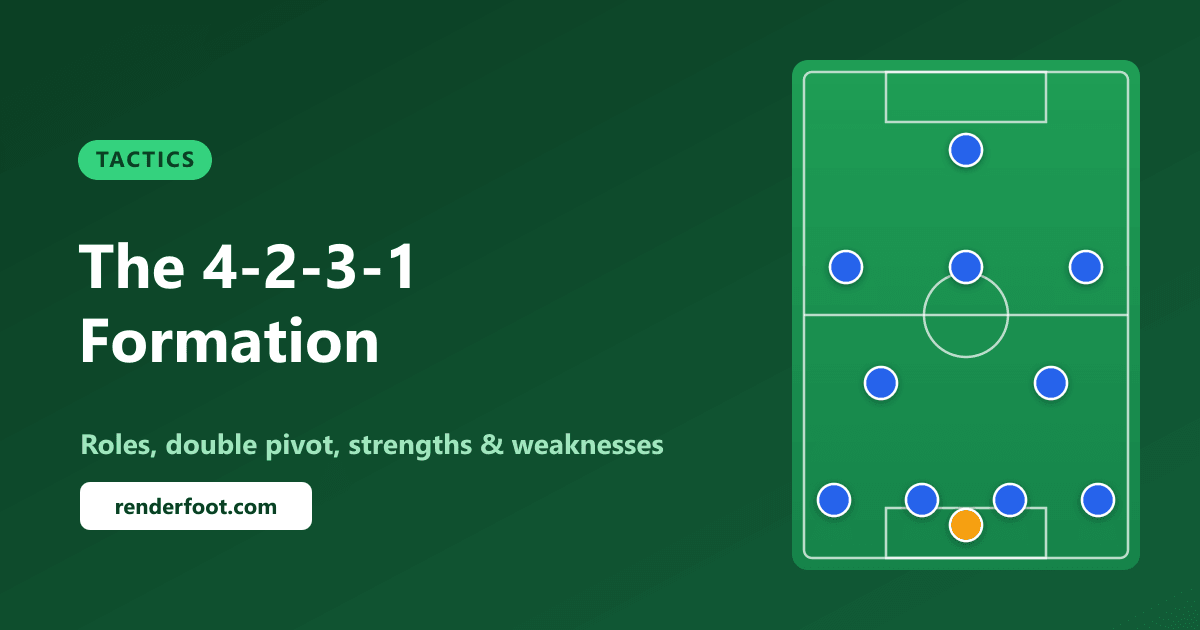
The most effective answer is a 4-2-3-1 or another shape with a number 10 and wide attackers. The space in a 5-3-2 sits in the channels outside the center-backs and behind the wing-backs — overload the flanks, pull a wing-back forward, then attack the gap behind. A creative 10 operating between the midfield three and the back five can also find pockets the defenders are reluctant to leave.
Frequently asked questions
What are the benefits of the 5-3-2 formation?
The 5-3-2 combines a very solid defensive structure with a real attacking threat. Three center-backs and a holding midfielder lock down the center, while two wing-backs provide width and two strikers create a constant counter-attacking outlet — making it excellent for staying compact and hitting teams on the break.
What is the main weakness of the 5-3-2?
Its biggest weakness is its dependence on the wing-backs. If they're forced to defend and can't get forward, the team loses all its width, the two strikers become isolated, and the 5-3-2 turns into a passive, deep block. Fatigue and 2v1 overloads out wide are the other main vulnerabilities.
What is the difference between 5-3-2 and 3-5-2?
They're the same players in the same system at different phases. In 3-5-2 the wing-backs are pushed high (attacking shape with five in midfield); in 5-3-2 they drop into the back line (defensive shape with five at the back). Teams shift between the two constantly during a match.
What is the best formation to beat a 5-3-2?
A 4-2-3-1 is often the best counter. It uses a number 10 to exploit the space between the opponent's midfield and back five, and wide attackers to overload the wing-backs and attack the channels outside the three center-backs.
Is the 5-3-2 a defensive formation?
It's defensively solid but not necessarily defensive. With wing-backs pushing on and two strikers, a 5-3-2 can attack with real numbers — it simply gives you a safety net of three center-backs to fall back on. How attacking it is depends on how high your wing-backs play.
Build your 5-3-2 lineup
Want to see the 5-3-2 with your own players? Open the free RenderFoot lineup builder, drop players into the back five, midfield three and front two, customize the colors and numbers, and export a clean graphic to share with your team. For more shapes, explore the full formations guide or compare it with the 4-2-3-1 and 4-3-3.