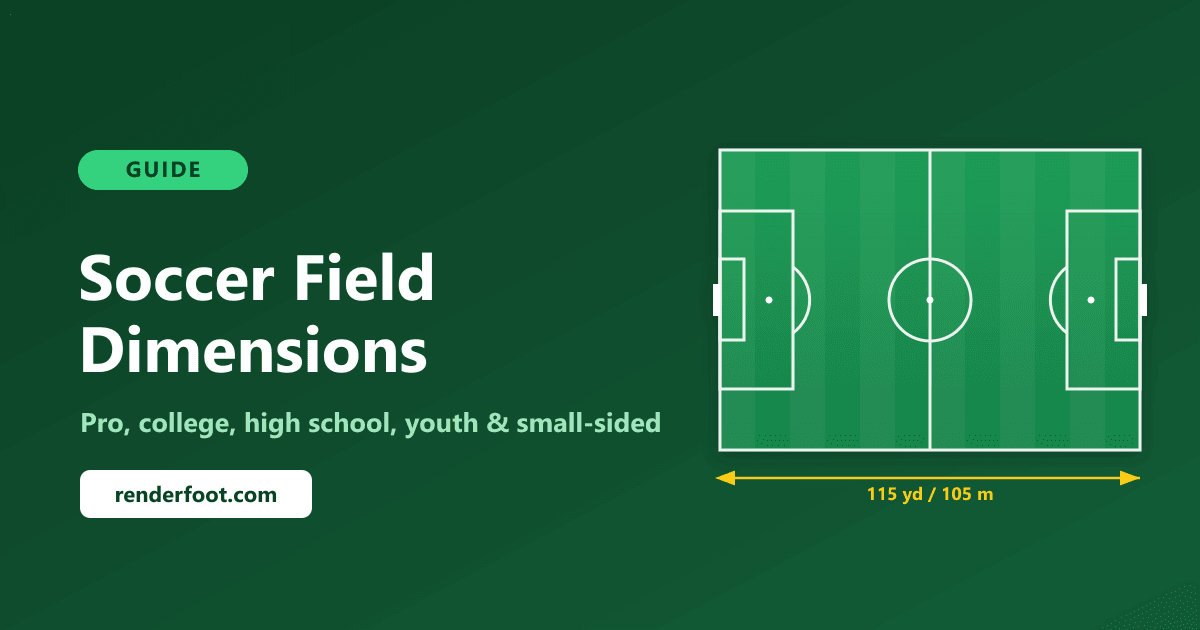
A regulation 11-a-side soccer field is 100–130 yards (90–120 m) long and 50–100 yards (45–90 m) wide. FIFA recommends a standard size of 115 × 74 yards (105 × 68 m), and goals are 8 yards wide by 8 feet high. Those ranges come straight from the IFAB Laws of the Game, and the field gets smaller for youth and small-sided formats.
Here's the complete breakdown — every measurement, every level of play, with a diagram you can reference.
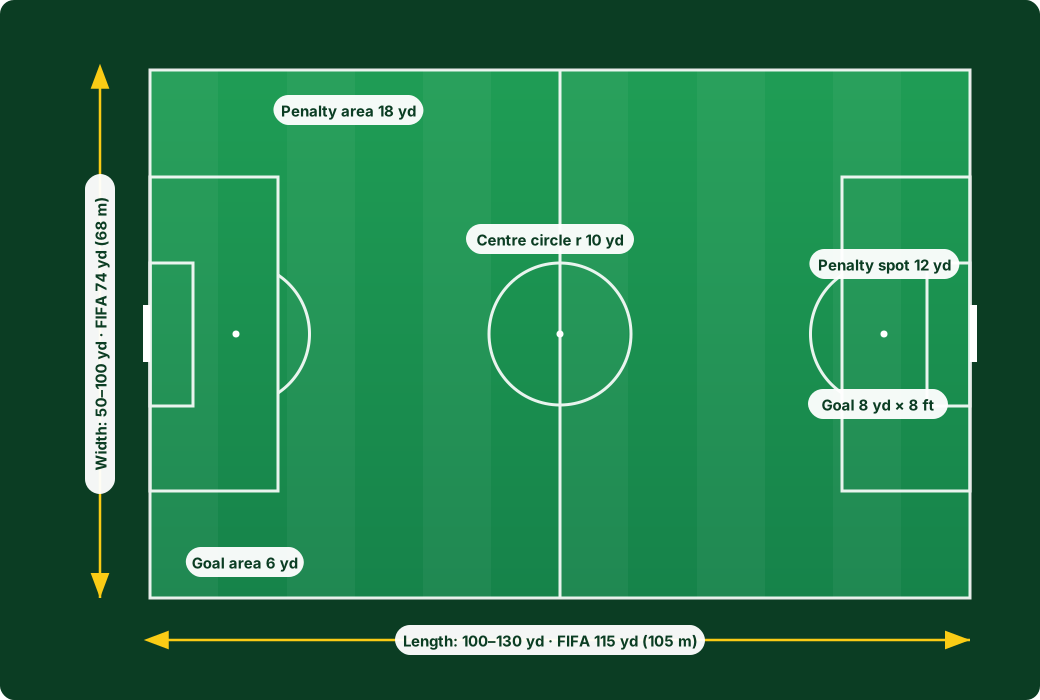
How big is a soccer field?
The quick answer, in every unit people ask for:
| Minimum | FIFA standard | Maximum | |
|---|---|---|---|
| Length (yards) | 100 yd | 115 yd | 130 yd |
| Length (metres) | 90 m | 105 m | 120 m |
| Length (feet) | 300 ft | 345 ft | 390 ft |
| Width (yards) | 50 yd | 74 yd | 100 yd |
| Width (metres) | 45 m | 68 m | 90 m |
| Width (feet) | 150 ft | 222 ft | 300 ft |
| Area (acres) | 1.0 | 1.76 | 2.7 |
So a typical professional pitch covers a little under two acres of grass. The Laws allow a wide range, but in practice almost every top-level stadium is built to the FIFA standard, which is why pitches look identical on television even though they legally don't have to be.
A note on words: "pitch" and "field" mean the same thing. British and international coverage says pitch, American coverage says field, and the Laws of the Game call it the field of play. Every measurement below applies to all three.
Standard soccer field dimensions (11v11)
Per IFAB Law 1 (The Field of Play), the field is a rectangle with these limits:
| Measurement | Domestic matches | International matches |
|---|---|---|
| Length (touchline) | 100–130 yd (90–120 m) | 110–120 yd (100–110 m) |
| Width (goal line) | 50–100 yd (45–90 m) | 70–80 yd (64–75 m) |
The length must always be greater than the width. For top stadiums, FIFA recommends a fixed 105 × 68 m (115 × 74 yd), which is why most professional pitches are nearly identical even though the Laws allow a range.
Note how much narrower the international band is. A club can legally play a domestic match on a 50-yard-wide field, but it could not host a UEFA or FIFA fixture there — those require at least 70 yards.
Field markings and key distances
Every line on a soccer field is part of the area it bounds — a ball on the line is still in. The key measurements:
- Goal: 8 yards (7.32 m) wide between the posts, 8 feet (2.44 m) high to the crossbar.
- Goal area (the "six-yard box"): 6 yards (5.5 m) from each post and 6 yards deep.
- Penalty area (the "18-yard box"): 18 yards (16.5 m) from each post and 18 yards deep.
- Penalty spot: 12 yards (11 m) from the goal line, centered.
- Penalty arc: a 10-yard (9.15 m) radius from the penalty spot, outside the box.
- Centre circle: 10-yard (9.15 m) radius.
- Corner arc: 1-yard (1 m) radius at each corner.
Two of these come up constantly in the run of play. The penalty area is the only place a goalkeeper may handle the ball, and it's where a foul becomes a penalty kick. The 10-yard radius is the distance defenders must retreat at a free kick, which is why the centre circle and penalty arc are both drawn at 10 yards — they're there to mark that distance for restarts.
Soccer field size by level of play
Within the IFAB range, each level tends to use a narrower band:
| Level | Length | Width |
|---|---|---|
| Professional / international | 110–120 yd | 70–80 yd |
| College (NCAA) | 115–120 yd | 70–75 yd |
| High school (NFHS) | 100–120 yd | 55–80 yd |
| Youth 11v11 (U13+) | 100–120 yd | 55–80 yd |
How big is a professional soccer field?
In practice, 115 × 74 yards (105 × 68 m). That's the FIFA-recommended size, and it is what nearly every purpose-built modern stadium uses. Older grounds sometimes sit a few yards off it because the stands were built before the recommendation existed and there is no room to expand the playing surface.
Small-sided field sizes (youth)
Younger players use smaller fields and fewer players, following U.S. Soccer's small-sided standards. Approximate field sizes:
| Format | Age group | Field size |
|---|---|---|
| 4v4 | U6–U8 | 25–35 yd × 15–25 yd |
| 7v7 | U9–U10 | 55–65 yd × 35–45 yd |
| 9v9 | U11–U12 | 70–80 yd × 45–55 yd |
| 11v11 | U13+ | full size (above) |
The step up matters more than the numbers suggest. Moving from 7v7 to 9v9 roughly doubles the playing area, and moving to full 11v11 doubles it again — which is why players who look comfortable at one age group can suddenly seem lost at the next. The field grew faster than they did.
Choosing a formation for one of these smaller pitches? See our guides to the best small-sided formations and the best 7v7 formations.
Soccer field vs. American football field
This is the most common question American fans ask, and the short answer is that a soccer field is significantly bigger — mostly because it is much wider.
| Soccer (FIFA standard) | American football | |
|---|---|---|
| Length | 115 yd | 120 yd (incl. two 10-yd end zones) |
| Playing length | 115 yd | 100 yd (between goal lines) |
| Width | 74 yd (222 ft) | 53⅓ yd (160 ft) |
| Area | ~8,510 yd² | ~6,400 yd² |
| Acres | ~1.76 | ~1.32 |
The width is the real gap: a soccer field is about 21 yards — over 60 feet — wider. Length is closer than people expect, because an American football field's 120 yards includes both end zones; its actual field of play is only 100 yards, shorter than a standard pitch.
That width difference is why shared stadiums are awkward. An NFL stadium hosting soccer usually has enough length but has to build out sideline space to reach the 70-yard minimum for international matches, and why some gridiron venues can only host soccer at the narrow end of the legal range.
How many acres is a soccer field?
About 1.76 acres at the FIFA standard size. Across the full legal range it runs from 1.0 acre at the smallest permitted dimensions to roughly 2.7 acres at the largest.
Indoor and futsal court dimensions
Indoor soccer and futsal are played on hard courts, not grass:
- Futsal (FIFA): 38–42 m × 20–25 m for international play (about 25 × 16 m at the small end), with smaller goals (3 m × 2 m).
- Indoor (arena) soccer: varies widely by venue, commonly around 200 × 85 ft, often with walls/boards in play.
Frequently asked questions
What are the dimensions of a standard soccer field?
A standard 11v11 soccer field is 100–130 yards long and 50–100 yards wide under IFAB Law 1. FIFA recommends 115 × 74 yards (105 × 68 m) for professional matches.
How long is a soccer field in yards?
Between 100 and 130 yards, with 115 yards the FIFA-recommended standard. International matches must be 110–120 yards.
How wide is a soccer field?
Between 50 and 100 yards, with 74 yards the FIFA standard. International matches require 70–80 yards.
How big is a soccer field in feet?
Roughly 300–390 feet long and 150–300 feet wide. The FIFA-recommended size is about 345 × 222 feet.
How big is a high school soccer field?
US high school (NFHS) fields are typically 100–120 yards long and 55–80 yards wide — within the same range as the pro game but often a little smaller.
Is a soccer field bigger than a football field?
Yes. A standard soccer field covers about 1.76 acres against roughly 1.32 for an American football field, and is over 20 yards wider. Football's 120-yard length includes two end zones; its playing field is only 100 yards.
Are all professional soccer fields the same size?
Not exactly, but they're close. The Laws allow a range, yet FIFA recommends 105 × 68 m, so most top stadiums build to that standard or very near it.
What is the difference between a soccer pitch and a soccer field?
Nothing — they are two names for the same surface. "Pitch" is the British and international term, "field" is the American one, and the Laws of the Game call it the field of play.
Plan your pitch and lineup
Now that you know the dimensions, map out your tactics on a correctly-proportioned pitch. Use the free RenderFoot tactical board to draw plays, or the lineup builder to set your formation — both use accurate field proportions. For tactics, start with our football formations for beginners guide.
Sources: IFAB Laws of the Game, Law 1; FIFA Stadium Guidelines — Pitch Dimensions.