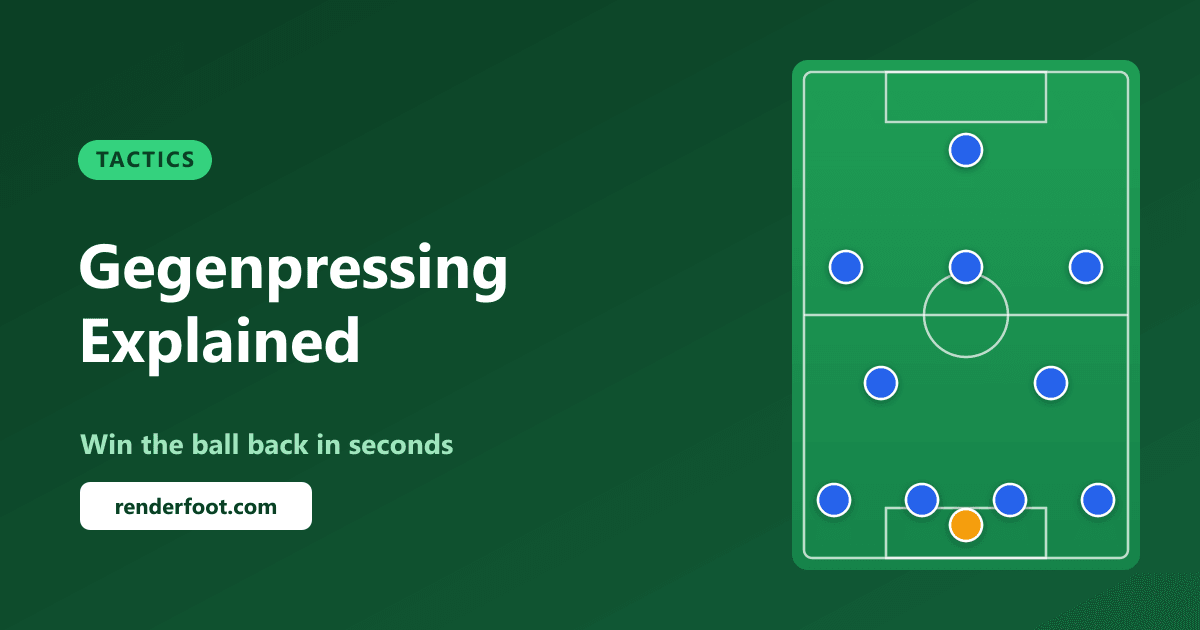
Gegenpressing is a tactic in which a team tries to win the ball back immediately after losing it, instead of retreating into its defensive shape. The players nearest the ball press the new ball-carrier within seconds, while he is still deciding what to do. The word is German for "counter-pressing."
The idea is that a team is at its most disorganized in the moment it wins the ball, so that is the best moment to take it back. This guide explains how it works, with diagrams, how it differs from a normal high press, and where the low block and "parking the bus" fit in.
How gegenpressing works
The trigger is losing the ball. What follows takes about five seconds.
- The nearest player presses the ball. He doesn't need to win it, only to stop the opponent from looking up and playing forward.
- The next players close the passing lanes. They step toward the ball-carrier's nearest teammates so that every short pass is risky.
- The team wins it, or drops. If the ball isn't won within a few seconds, the team falls back into its defensive shape.
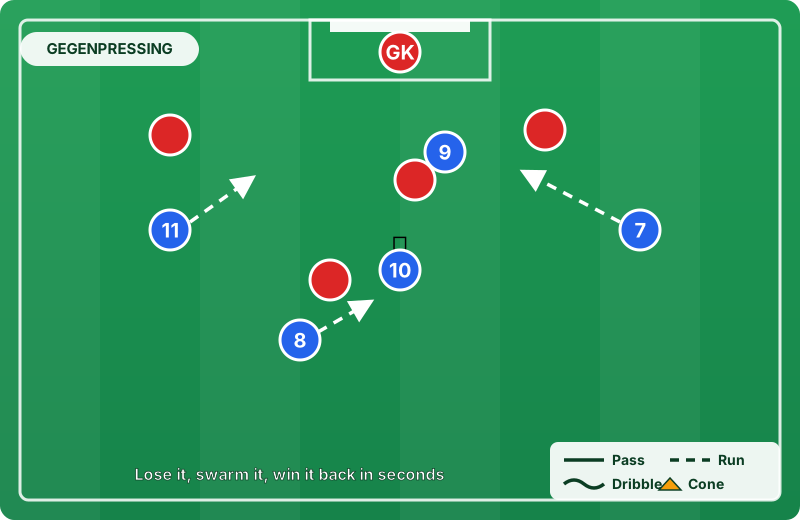
Watch what the blue players do when the ball is lost. Nobody runs back toward their own goal. The 9 and 10 squeeze the defender from both sides, the wingers cut off the passes out wide, and the 8 waits for the one pass that is left. When it comes, he is already moving.
The ball is won about 25 yards from goal, with the defense facing the wrong way. That is why Jürgen Klopp, explaining the tactic on Sky Sports in 2016, said that no playmaker in the world can be as good as a good counter-pressing situation.
Gegenpressing vs high press: what's the difference?
The two are often confused. They happen at different moments.
| Gegenpressing (counter-press) | High press | |
|---|---|---|
| When | The moment the ball is lost | When the opponent has settled possession, such as a goal kick |
| Trigger | Your own lost pass, tackle or shot | A cue: a pass to a full-back, a poor touch, a back-pass |
| Shape | Whoever is nearest, from attacking positions | The team's organized defensive shape, pushed up |
| Lasts | A few seconds | As long as the opponent builds from the back |
A team can do one without the other, though most pressing teams do both.
High press, mid block and low block
Once the first few seconds have passed, a team has to choose where on the pitch it starts defending. Coaches describe three heights.
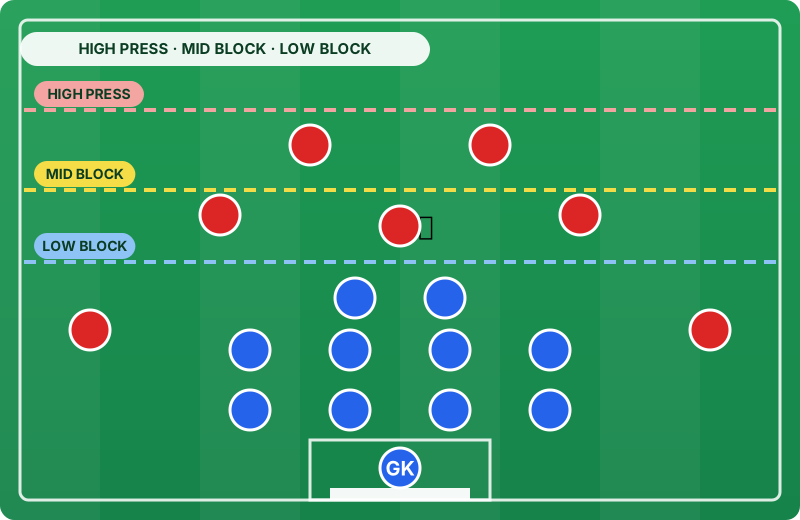
- High press. The team defends in the opponent's third, trying to win the ball near goal. The reward is high and so is the risk, because there is space behind the defense.
- Mid block. The team lets the opponent's defenders have the ball and starts pressing around the halfway line. It is the most common choice, a balance between the other two.
- Low block. The team defends near its own penalty area in two compact lines, as in the diagram. There is no space behind the defense and little between the lines, but the team has a long way to go when it wins the ball.
What does "park the bus" mean?
Parking the bus is slang for an extreme low block: nearly every player behind the ball, deep and narrow, with little attempt to attack. José Mourinho popularized the phrase in England in 2004, complaining that an opponent had "brought the bus and left the bus in front of the goal." It is usually said as a criticism, but it is a legitimate way for a weaker team to stay in a game.
Who invented gegenpressing?
The idea developed over decades. Coaches such as Valeriy Lobanovskyi at Dynamo Kyiv and Arrigo Sacchi at AC Milan built teams around collective pressing in the 1970s and 80s.
In Germany, Ralf Rangnick is widely credited with developing the modern version. He has said the idea took shape after his team played a friendly against Lobanovskyi's Dynamo Kyiv in 1984, and he counts Lobanovskyi and Sacchi among his main influences.
Jürgen Klopp made it famous. His Borussia Dortmund won the Bundesliga in 2010–11 and 2011–12, and his Liverpool won the Champions League in 2018–19 and the Premier League in 2019–20, all with counter-pressing at the center of how they played. Pep Guardiola's teams use it too, as the defensive half of tiki-taka.
For more on the coaches and variations, see the Coaches' Voice guide to counter-pressing.
What gegenpressing needs
- Short distances between players. A team can only swarm the ball if it has players near it. Teams that attack with players close together are already in position to counter-press.
- Fitness. Repeated short sprints for 90 minutes, from every outfield player including the forwards.
- A shared trigger. If one player presses and the rest drop, the press is broken with one pass.
- A high defensive line to keep the team compact, and a goalkeeper who can cover the space behind it.
Which formation is best for gegenpressing?
Klopp's Dortmund mostly used a 4-2-3-1 and his Liverpool a 4-3-3. Both put three or four players high and central, close to where the ball is usually lost. The formation matters less than the distances: any shape works if the players are close enough to press together.
You can sketch your own press on the free RenderFoot tactical board. Mark where the ball is lost, then draw who presses the ball and who covers each passing lane, so every player knows their job before the session starts.
How pressing is measured
The most common statistic is PPDA, or passes per defensive action: the number of passes the opponent makes divided by the pressing team's defensive actions (tackles, interceptions, fouls). A lower number means more intense pressing. Coaches' Voice has a full explanation of PPDA. To check how your own team presses, film a match and review it with one of the tools in our video analysis software guide.
How to beat gegenpressing
- Play through the first wave. One quick, accurate pass past the pressing players leaves them behind the ball and the defense exposed.
- Go long. A direct ball over the top skips the press entirely and attacks the high defensive line.
- Switch the play. The press crowds one side of the pitch, so the far side is empty.
- Stay calm. Pressing works by forcing rushed decisions. Players who are comfortable receiving under pressure take away its main weapon.
The other weakness is fatigue. A team that presses at full intensity for a whole season risks tired legs and injuries, which is why most teams now choose their moments.
Frequently asked questions
What is gegenpressing in simple terms?
Gegenpressing means trying to win the ball back the instant you lose it. Instead of running back to defend, the nearest players immediately pressure the opponent who has the ball, before he has time to pass forward.
What does gegenpressing mean in English?
It means "counter-pressing." Gegen is German for "against" or "counter." The name describes pressing against the opponent's counter-attack before it can start.
How do you pronounce gegenpressing?
Roughly "GAY-gen-pressing," with a hard G at the start of both syllables.
Who invented gegenpressing?
Ralf Rangnick is widely credited with developing it in Germany, building on the pressing of Valeriy Lobanovskyi and Arrigo Sacchi. Jürgen Klopp made it famous with Borussia Dortmund and Liverpool.
What is a low block in soccer?
A low block is a defensive setup in which a team defends deep, close to its own penalty area, usually in two compact lines of four. It leaves no space behind the defense, at the cost of giving the opponent the ball and territory.
What is the difference between pressing and gegenpressing?
Pressing is any organized attempt to win the ball from an opponent in possession. Gegenpressing is pressing at one specific moment: right after your own team has lost the ball.
Do teams still use gegenpressing?
Yes. Counter-pressing is now a standard part of the game at the top level, used by most leading teams, though usually in bursts rather than for the full 90 minutes.
Keep learning
Read how tiki-taka uses the ball to control a game, how the false 9 pulls a defense apart, or look up any term in the soccer terms glossary.