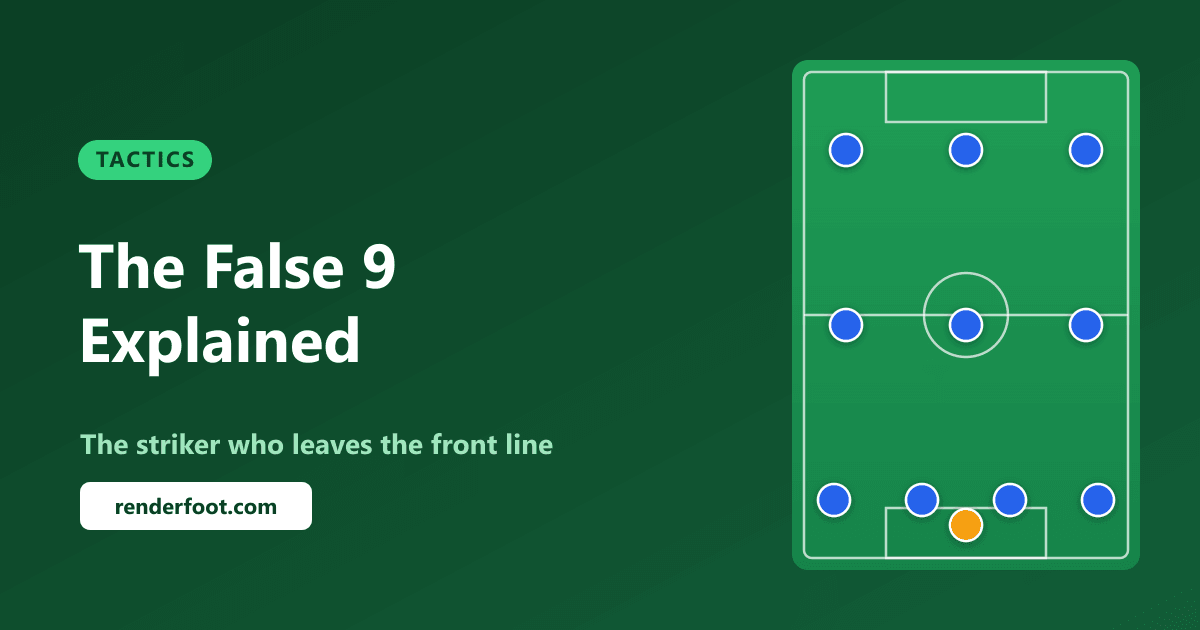
A false 9 is a center-forward who starts in the striker's position but repeatedly drops deep into midfield instead of staying on the last line of defense. The movement leaves the opposing center-backs with nobody to mark and a decision to make: follow the striker and leave a gap behind them, or stay put and let him receive the ball unmarked.
The name comes from the shirt number. The number 9 is the traditional striker, so a 9 who doesn't behave like one is a "false" 9. This guide explains how the role works, with animated diagrams of both outcomes, the players who defined it, and how teams defend against it. For the traditional roles, see our forward positions guide.
False 9 vs a traditional number 9
| Traditional 9 | False 9 | |
|---|---|---|
| Starting position | On the shoulder of the center-backs | The same, on paper |
| Movement | Runs in behind, attacks crosses | Drops toward the ball, into midfield |
| Main job | Finish chances | Create space and link play, then score |
| Occupies | Both center-backs | Nobody, which is the whole point |
| Key skills | Finishing, heading, hold-up play | First touch, vision, passing, dribbling |
| Who scores | The striker | Often the wingers and midfielders |
A false 9 is not simply a striker who is bad at staying forward. The role only works when the space he leaves is attacked by someone else.
How the false 9 works
Everything starts with one movement: the 9 leaves the front line and drops into the space between the opponent's midfield and defense. What happens next depends on the center-backs.
Option 1: the center-back follows
If a center-back tracks the 9 into midfield, he leaves a hole in the back line. A winger or midfielder runs into it, and the 9 only has to play the pass.
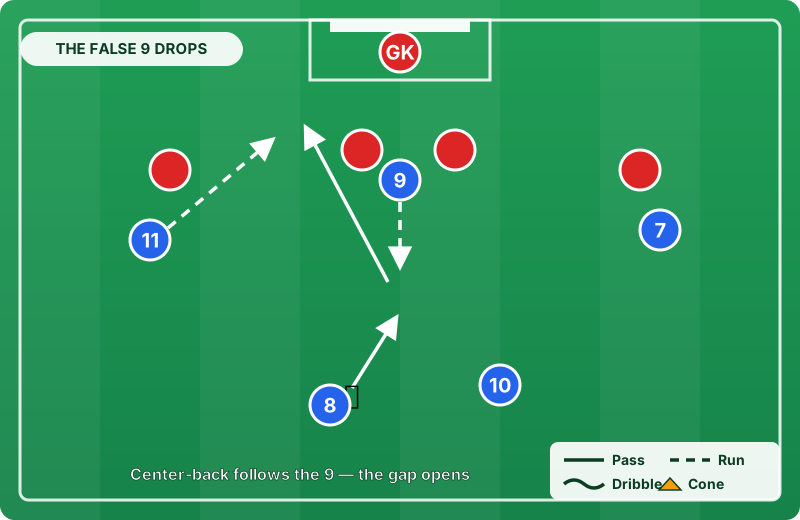
Watch the timing of the winger. The 11 starts his run when the center-back commits, not before, and he is still level with the full-back when the pass is played, so he stays onside. For the detail of that rule, see our offside guide.
Option 2: the center-backs stay
If neither center-back follows, the 9 receives the ball with time to turn. The attacking team now has an extra player in midfield, and the 9 can run straight at a back line that is standing still.
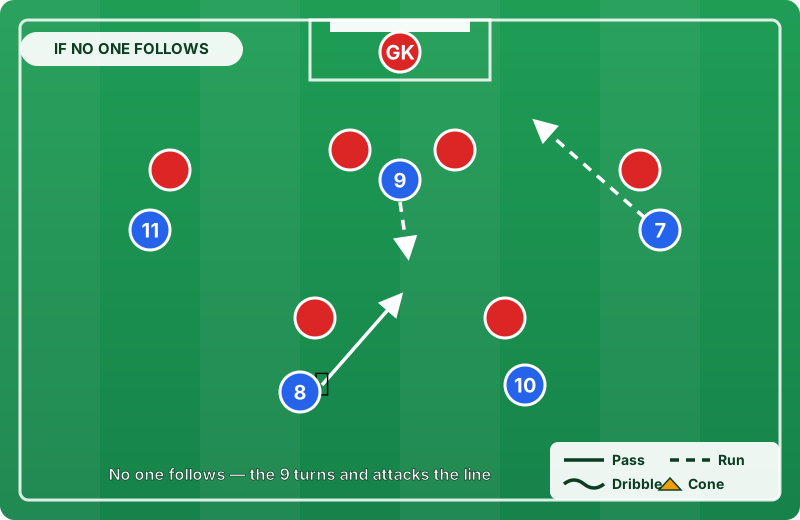
Either way the defense loses something. That dilemma is the false 9 in one sentence: follow him and leave a gap, or leave him and give him the ball.
What a false 9 needs
- A midfielder's first touch. He receives with his back to goal and a defender close behind, usually on the half-turn.
- Vision and passing. The role is judged on the runs he finds as much as the goals he scores.
- Timing. Drop too early and the center-back simply passes him on to a midfielder. Drop too late and the pass is gone.
- Teammates who run beyond him. Without wingers or midfielders attacking the space, a false 9 just leaves the penalty area empty.
That last point is why the role is rare at youth level. It asks three or four players to read the same cue at the same moment.
The best false 9s
The idea is older than the name. These are the players most often cited, in order:
- Matthias Sindelar (Austria, 1930s). The center-forward of Austria's "Wunderteam" dropped away from the front line decades before the term existed.
- Nándor Hidegkuti (Hungary, 1950s). Playing as a deep-lying center-forward, he scored a hat-trick in Hungary's 6–3 win over England at Wembley on 25 November 1953. England's center-half had no idea whether to follow him.
- Francesco Totti (Roma). From the 2005–06 season, coach Luciano Spalletti used Totti as a lone forward who dropped into midfield, in a shape later described as a 4-6-0. Totti won the European Golden Shoe in 2006–07 with 26 Serie A goals.
- Lionel Messi (Barcelona). Pep Guardiola moved Messi from the right wing into the center for the 6–2 win at Real Madrid on 2 May 2009. It became the best-known use of the role.
- Cesc Fàbregas (Spain). Spain played without a recognized striker in several games at Euro 2012, including the 4–0 win over Italy in the final, with the midfielder Fàbregas as the false 9.
- Roberto Firmino (Liverpool). Jürgen Klopp used Firmino as a false 9 in a front three with Mohamed Salah and Sadio Mané, who scored most of the goals from the wings.
For the history of the role, see the false 9 section of Wikipedia's Forward article and the Coaches' Voice explainer.
Which formations use a false 9?
The role fits any shape with one central forward and runners around him.
- 4-3-3. The classic setup. The 9 drops, the two wingers run inside into the space. See the base shape on our 4-3-3 formation page and the 4-3-3 tactics guide.
- 4-2-3-1. The 9 drops toward the number 10, and the wide players or the 10 himself run beyond. See the 4-2-3-1 guide.
- 4-6-0. The extreme version: no fixed forward at all, with midfielders taking turns to arrive in the box.
Want to test it with your own team? Set up a 4-3-3 on the free RenderFoot tactical board, drag the 9 into midfield, and draw the winger's run into the gap. It takes a minute and shows your players exactly what you mean.
How to defend against a false 9
There are three common answers, and each has a cost.
- Pass him on. The center-backs hold the line and a defensive midfielder picks up the 9 when he drops. This is the standard solution, and it is why teams facing a false 9 often play two holding midfielders.
- Follow him, and cover. One center-back tracks the 9 while the other center-back and the full-backs narrow to close the gap. It needs a quick, well-drilled back line.
- Sit deeper. A low block leaves no space behind the defense to run into, which removes the main threat. The cost is giving up the ball and territory.
Advantages and disadvantages
Advantages
- Creates an extra player in midfield, which helps a team keep the ball
- Pulls center-backs out of position and opens space for runners
- Hard to mark with a traditional back four
Disadvantages
- Nobody in the penalty area to attack crosses
- Depends on wingers and midfielders timing their runs
- Less effective against a deep, compact defense that leaves no space behind
Frequently asked questions
What is a false 9 in soccer?
A false 9 is a center-forward who drops deep into midfield instead of staying up front. By leaving the front line he pulls center-backs out of position or receives the ball unmarked, creating space for wingers and midfielders to run into.
Is a false 9 a striker or a midfielder?
On the team sheet a false 9 is a striker, because he starts in the center-forward position. In the game he spends much of his time in midfield, so he needs a midfielder's passing and touch as well as a forward's finishing.
What is the difference between a false 9 and a number 10?
A number 10 starts in midfield behind a striker. A false 9 starts as the striker and drops into the 10's space, which leaves no striker at all. The 10 has a center-forward ahead of him to pass to; the false 9 relies on wingers and midfielders running beyond him.
Who invented the false 9?
No single person. Austria's Matthias Sindelar played a similar role in the 1930s, and Hungary's Nándor Hidegkuti made it famous in 1953. The modern version is most associated with Luciano Spalletti's Roma and Pep Guardiola's Barcelona.
Was Messi a false 9?
Yes. Messi played as a false 9 for Barcelona under Pep Guardiola, starting with the 6–2 win at Real Madrid in May 2009. He had previously played on the right wing, and later in his career he played as a number 10 and right-sided forward.
What formation is best for a false 9?
The 4-3-3 is the most common, because the two wingers are already positioned to run into the space the 9 leaves. A 4-2-3-1 also works when the wide players are goal threats.
What number does a false 9 wear?
Usually the number 9, since he starts in the striker's position, though many have worn 10. The name describes the role, not the shirt.
Keep learning
The false 9 is one of several ideas that changed how the modern game is played. Read how tiki-taka used it to control possession, how gegenpressing wins the ball back, or look up any term in the soccer terms glossary.