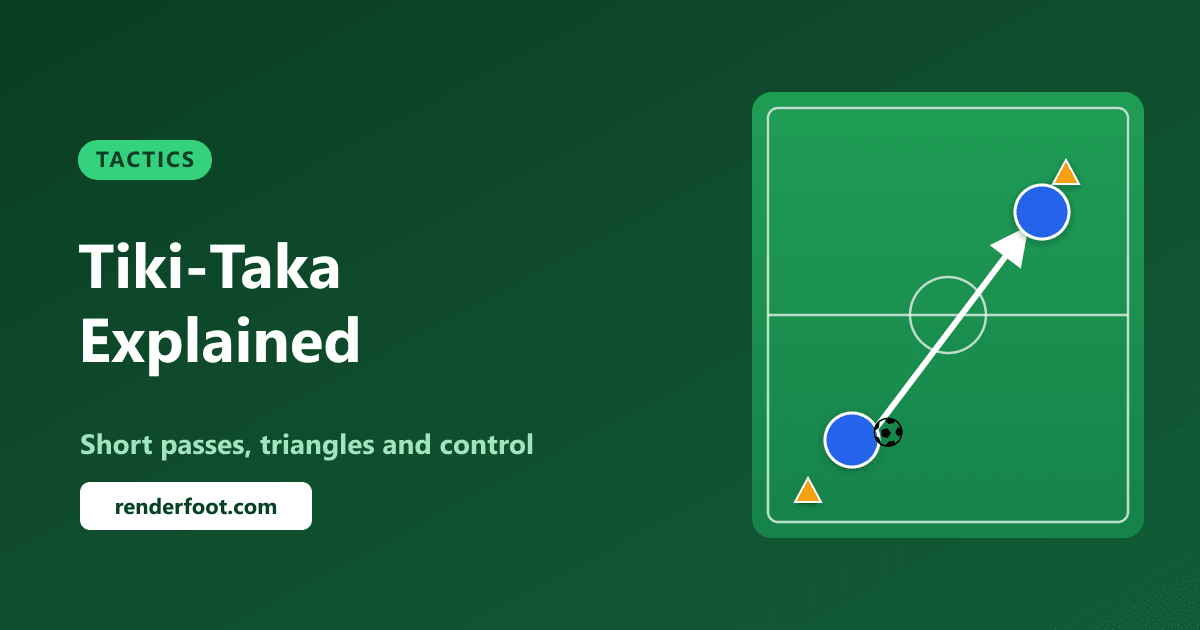
Tiki-taka is a style of soccer built on short, quick passes, constant movement, and keeping the ball for long periods. The team passes in triangles to move the opponent from side to side, and attacks when a gap opens. It is most associated with Pep Guardiola's Barcelona and the Spain team that won three major tournaments between 2008 and 2012.
The idea is simple: if you have the ball, the other team can't score. This guide explains how it works on the pitch, with diagrams, where it came from, and why some of the coaches linked to it dislike the word. (If you came looking for the grid game, that's our football tic-tac-toe.)
The principles of tiki-taka
Tiki-taka is not a formation. It is a set of habits that every player on the team follows.
- Short passes. Most passes travel a few yards, along the ground, to a teammate's feet.
- Triangles. The player on the ball should always have at least two close options.
- Pass and move. After passing, a player moves to a new angle to become an option again.
- Patience. The team keeps circulating the ball until the defense makes a mistake.
- Win it back quickly. When the ball is lost, the nearest players press at once.
Passing triangles
The shape that makes it possible is the triangle. In a 4-3-3, almost every player is connected to two or more teammates by a short passing lane, so whoever has the ball is never isolated.
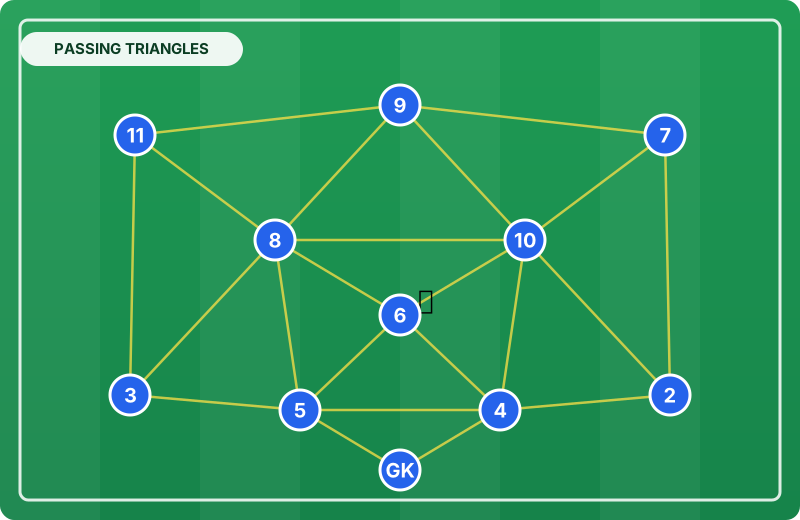
Count the lines running to the number 6. He has five options within a short pass, which is why the holding midfielder is the hub of a possession team. Our midfield positions guide covers that role in detail.
Moving the block
A common mistake is to think the passes are the point. They aren't. Each pass forces the defenders to shift, and the passing continues until they shift too slowly.
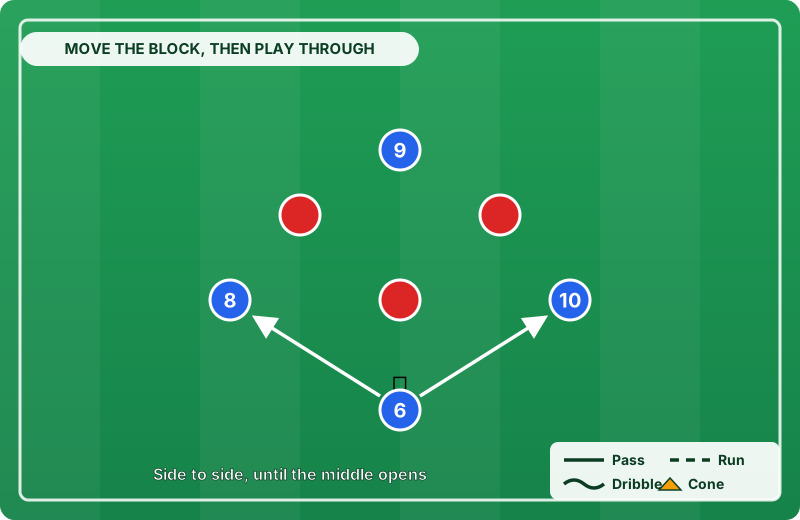
Watch the three defenders rather than the ball. At the start, the pass into the striker is blocked. After two switches they are stretched, the central lane is open, and one vertical pass takes all three out of the game.
Where tiki-taka came from
The style grew out of Dutch Total Football. Johan Cruyff brought those ideas to Barcelona as a coach between 1988 and 1996, and they became the basis of how the club taught the game at every age group.
The name came later. Spanish broadcaster Andrés Montes is generally credited with popularizing the phrase "tiki-taka" in his commentary for LaSexta during the 2006 World Cup. It imitates the sound of quick, light touches.
The style then had its great period:
- Spain won Euro 2008 under Luis Aragonés, then the 2010 World Cup and Euro 2012 under Vicente del Bosque.
- Barcelona won 14 trophies in four seasons under Pep Guardiola (2008–2012), including six in the calendar year 2009.
Xavi, Andrés Iniesta, and Sergio Busquets played in midfield for both teams. Lionel Messi's move to a false 9 role gave Barcelona an extra passer in the middle of the pitch.
For the full history, see the Tiki-taka article on Wikipedia.
Why Guardiola dislikes the word
Guardiola has rejected the label. In Martí Perarnau's 2014 book Pep Confidential, he is quoted as saying: "I loathe all that passing for the sake of it, all that tiki-taka. It's so much rubbish and has no purpose."
His objection is to passing without intent. Coaches from this school prefer the term positional play (juego de posición): players hold set zones so that the ball can always move, and the passing has a target, which is to get a player free facing the opponent's goal. Tiki-taka describes what it looks like. Positional play describes why it is done.
What tiki-taka needs
- Technical players in every position, including a goalkeeper and center-backs who are comfortable passing under pressure.
- A holding midfielder who is always available and rarely gives the ball away.
- Movement off the ball. A triangle only exists if the players without the ball keep adjusting.
- Pressing after losing the ball. Guardiola's Barcelona are often described as having a five- or six-second rule for winning it back. Because the players are close together when they pass, they are also close together when they lose it. That is the same idea behind gegenpressing.
Which formation is best for tiki-taka?
The 4-3-3 is the classic choice. It creates triangles all over the pitch, puts three players in central midfield, and keeps two wingers wide to stretch the defense. Barcelona and Spain both used it, with Spain sometimes switching to a 4-2-3-1 or playing without a striker.
A 4-2-3-1 also suits the style, since the double pivot gives the defenders two safe passing options. Formations with two flat lines, such as a 4-4-2, produce fewer natural triangles.
Draw your own team's triangles on the free RenderFoot tactical board: place your players, connect each one to his two nearest teammates, and you'll see at once who is isolated.
How to train it
The basic exercise is the rondo: a circle of players keeping the ball away from one or two defenders in the middle. It trains first touch, body shape, and quick decisions in a small space. You'll find versions for different ages in our passing drills and the U12 practice plan, and you can build a full session in the drill planner.
How to beat tiki-taka
No style wins forever. The answers teams found were:
- A compact low block. Defending deep and narrow removes the gaps that the passing is designed to open. Inter Milan (2010) and Chelsea (2012) both knocked Barcelona out of the Champions League this way.
- Fast counter-attacks. A team that commits many players to passing leaves space behind its full-backs.
- An organized high press. Pressing the goalkeeper and center-backs stops the passing before it starts.
The common criticism is that possession can become an end in itself: a lot of the ball and few shots. Spain's group-stage exit at the 2014 World Cup is the usual example.
Frequently asked questions
What does tiki-taka mean?
Tiki-taka is a Spanish term for a style of soccer based on short, quick passing and movement to keep possession. The phrase imitates the sound of rapid one-touch passes and was popularized by Spanish commentator Andrés Montes in 2006.
Who invented tiki-taka?
No single coach. Its roots are in Dutch Total Football, which Johan Cruyff brought to Barcelona. Luis Aragonés and Vicente del Bosque used it with Spain, and Pep Guardiola took it furthest with Barcelona from 2008 to 2012.
Is tiki-taka still used?
In its pure form, rarely. Its principles are everywhere, though: goalkeepers who pass, building play from the back, and pressing immediately after losing the ball are now standard at the top level. Guardiola's later teams play a faster, more direct version.
What is the difference between tiki-taka and Total Football?
Total Football is about players swapping positions freely, so that any player can fill any role. Tiki-taka kept the movement and technique but put the short pass at the center of everything.
What is the difference between tiki-taka and gegenpressing?
Tiki-taka is about what a team does with the ball: keep it, and move the opponent. Gegenpressing is about what it does the moment it loses the ball: press at once to win it back. Many modern teams do both.
What positions matter most in tiki-taka?
The central midfielders, above all the holding midfielder, who links the defense to everyone else. Ball-playing center-backs and a goalkeeper who can pass are also essential.
Keep learning
Read how the false 9 gave tiki-taka its extra midfielder, how gegenpressing answers it, or start with the basics in our formations guide for beginners.