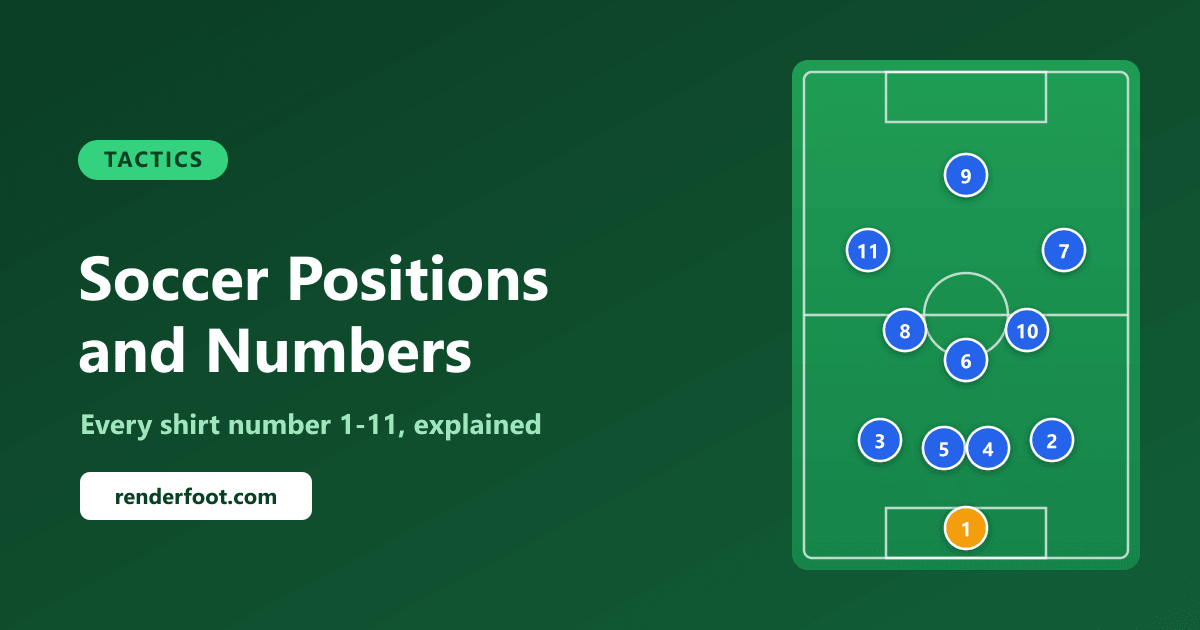
The midfield positions in soccer are the defensive midfielder (CDM), central midfielder (CM), and attacking midfielder (CAM), plus wide midfielders in some systems. The CDM (number 6) protects the defense, the CM (number 8) links both ends, and the CAM (number 10) creates chances for the strikers.
The midfield is the engine room of the team: it controls the tempo, wins the ball back, and usually decides who wins the game. This guide explains each role in detail, with animated diagrams of what the CDM and CAM actually do on the pitch. For how the midfield connects to the rest of the team, see our soccer positions and numbers guide.
The midfield at a glance

A classic midfield three has one player in each band: a holder (6), a runner (8), and a creator (10). The shape changes with the formation, but every system needs someone to protect the back line, someone to cover ground, and someone to unlock the defense.
| Position | Abbreviation | Usual number | Main job | Plays |
|---|---|---|---|---|
| Defensive midfielder | CDM / DM | 6 | Shield the defense, start attacks | Just in front of the center-backs |
| Central midfielder | CM | 8 | Link defense and attack, box to box | Center of the pitch |
| Attacking midfielder | CAM / AM | 10 | Create chances, link with the strikers | Between the opponent's midfield and defense |
| Wide midfielder | LM / RM | 11 / 7 | Provide width, cross, track back | On the flanks |
The abbreviations CDM and CAM were popularized by EA Sports' FIFA (now EA Sports FC) video games. Coaches more often say "holding midfielder" or "the 6" and "number 10" or "playmaker," but they mean the same positions.
What is a CDM in soccer?
A CDM (central defensive midfielder) is the midfielder who plays deepest, directly in front of the center-backs. They protect the back line, break up the opponent's attacks, and play the first pass that starts their own team's attack. The CDM usually wears number 6 and is often called the "holding midfielder," "anchor," or "pivot."
The CDM rarely gets the headlines, but it is the position coaches trust most. If the 6 is caught out of position, the center-backs are exposed to a direct run at goal.
What a CDM does in and out of possession
- Out of possession: screens passes into the opponent's striker, closes the space between the defensive and midfield lines, intercepts, tackles, and wins second balls.
- In possession: gives the center-backs and goalkeeper a safe passing option, switches play, and dictates the tempo with short and long passing.
- In transition: is the first player to slow down an opponent's counter-attack, usually by stepping in or committing a smart tactical foul.
The CDM in action: dropping between the center-backs
One of the most important things a modern 6 does is drop between the two center-backs when the team builds from the back. The center-backs split wide, the full-backs push on, and a two-against-two against the opponent's strikers becomes a three-against-two. The move is sometimes called the salida lavolpiana, after the Argentine coach Ricardo La Volpe.
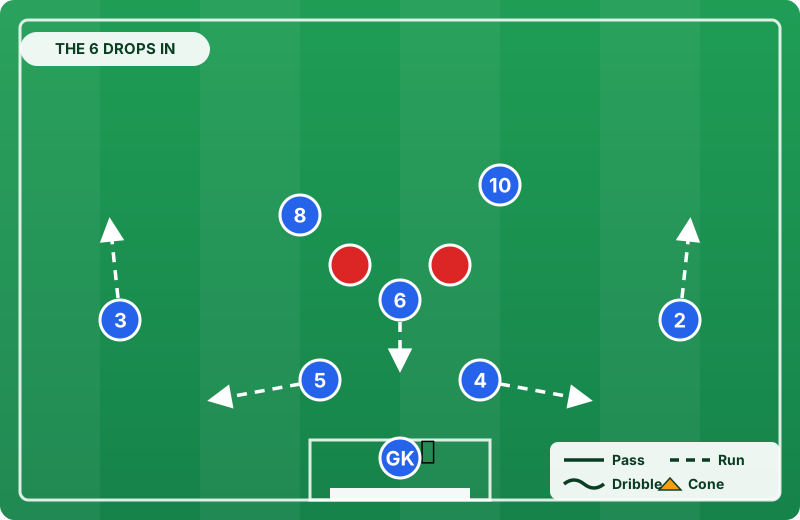
Watch the timing: the 6 drops before the goalkeeper plays, so the pass is on the moment the strikers commit. When the striker presses the 6, the free center-back has space to carry the ball up the pitch.
CDM attributes
Positional discipline, reading of the game, tackling and interceptions, composure under pressure, and a wide passing range. Pace helps, but anticipation matters more: the best 6s are already in the passing lane before the pass is played.
Examples of the type: Rodri, Sergio Busquets, Casemiro, Declan Rice, N'Golo Kanté, and Claude Makélélé, whose name became shorthand for the role ("the Makélélé role").
Central midfielder (CM) — number 8
The central midfielder is the box-to-box engine, covering the whole length of the pitch.
- Job: link defense and attack, support both phases, press the opponent's midfield, and arrive late in the box to score. The all-rounder of the team.
- Attributes: stamina above all, plus passing, ball-carrying, and the timing to join attacks.
- Examples of the type: Jude Bellingham, Federico Valverde, Steven Gerrard, Yaya Touré.
In a 4-3-3, two 8s play either side of a single 6. In a 4-2-3-1, the 8 often becomes one half of a double pivot alongside the 6.
What is a CAM in soccer?
A CAM (central attacking midfielder) is the most advanced central midfielder, playing just behind the striker. Their job is to create goal-scoring chances: receiving the ball between the opponent's lines, turning, and playing the final pass, or shooting themselves. The CAM traditionally wears number 10 and is often called the "playmaker" or simply "the 10."
The CAM is the creative hub of the attack. It sits at the heart of the 4-2-3-1 and of the diamond in a 4-4-2.
The CAM in action: finding the pocket
The space the CAM lives in is called the pocket, or "between the lines": the gap between the opponent's midfield line and their defensive line. A 10 who receives there and turns forces a defender to make a choice. If the center-back steps out to press, a gap opens behind him.
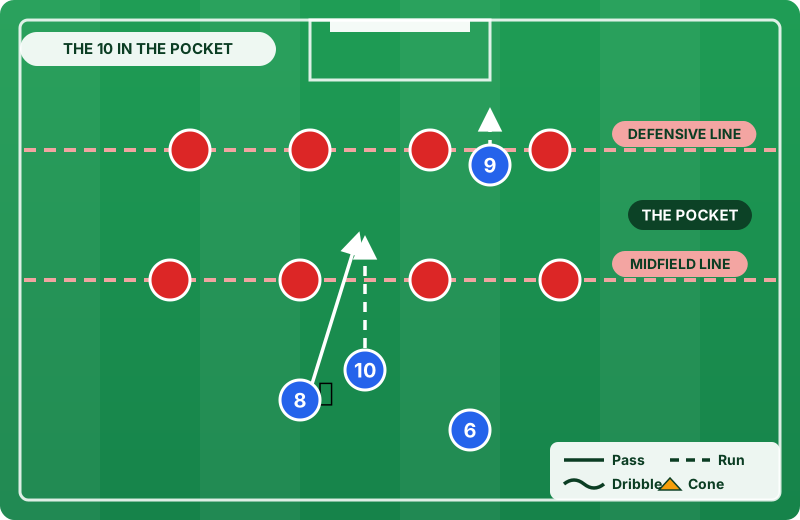
That is the CAM's whole game in one move: get between the lines, receive on the half-turn, and punish whichever defender reacts.
CAM attributes
Vision, first touch and the ability to receive on the half-turn, quick combination play, a killer final pass, and the confidence to shoot from the edge of the box. The best 10s also know when not to drop deep: a CAM who comes too far back to get the ball leaves the striker isolated.
Examples of the type: Kevin De Bruyne, Martin Ødegaard, Jamal Musiala, Bruno Fernandes, Mesut Özil, Zinedine Zidane, Kaká.
CDM vs CAM: what's the difference?
The CDM and CAM are opposite ends of the same central channel. The CDM defends first and builds play from deep; the CAM attacks first and creates chances near the box.
| CDM (number 6) | CAM (number 10) | |
|---|---|---|
| Where they play | In front of the center-backs | Behind the striker, between the opponent's lines |
| First priority | Protect the defense | Create chances |
| Key skills | Positioning, tackling, interceptions, passing range | Vision, first touch, final pass, shooting |
| In possession | Starts attacks, controls tempo | Unlocks the defense, plays the final pass |
| Out of possession | Screens the striker, wins the ball | Presses the opponent's 6, blocks passing lanes |
| Typical stats | Tackles, interceptions, passes completed | Assists, key passes, chances created |
| Modern examples | Rodri, Rice, Casemiro | De Bruyne, Ødegaard, Musiala |
A useful rule of thumb: if the player's best moment is a recovered ball, they are a 6. If it's an assist, they are a 10. The CM (8) sits between them and needs some of both.
Single pivot vs double pivot
A pivot is the deepest midfield position. Whether a team plays one or two players there changes the whole shape of the midfield.

- Single pivot (4-3-3, 4-1-4-1): one 6 holds while two 8s push forward. More attacking players, but the 6 must cover a lot of ground alone.

- Double pivot (4-2-3-1, 4-2-2-2): two holding midfielders side by side. Safer in transition and great for building out, but it leaves fewer players in attack. This is the setup that frees a CAM to stay high.
Read the full breakdowns in our 4-3-3 tactics guide and 4-2-3-1 formation guide.
Midfield role variations
Within each position there are specialist roles. You'll hear these names in commentary and tactical analysis:
- Anchor / destroyer (6): a pure ball-winner who rarely ventures forward. Think Makélélé or Kanté.
- Regista / deep-lying playmaker (6): a holding midfielder whose main weapon is passing rather than tackling. Andrea Pirlo is the classic example.
- Box-to-box midfielder (8): covers the full pitch, contributing tackles and goals.
- Mezzala (8): an Italian term for a central midfielder who drifts wide into the half-space to attack.
- Trequartista (10): a free-roaming playmaker with few defensive duties; Francesco Totti and Roberto Baggio defined the role.
- Shadow striker (10): an attacking midfielder who makes runs beyond the striker to score, rather than mainly creating.
These descriptions are commonly used in tactical writing; see the Midfielder article on Wikipedia for the history of each.
Wide midfielders
In a 4-4-2 or 4-5-1, the midfield also includes wide midfielders on the right (7) and left (11). They provide width, track back to help the full-backs, and deliver crosses: a more defensive cousin of the winger. Learn the attacking version in our forward positions guide.
Plan your midfield
Want to see how a single pivot compares to a double pivot with your own players? Drag them into place in the free RenderFoot lineup builder, or sketch the 6's drop and the 10's movement between the lines on the tactical board and share it with your team. To check whether your own 6 and 10 are finding these spaces in matches, film a game and review it with one of the tools in our football video analysis software guide.
Frequently asked questions
What are the midfield positions in soccer?
The three core midfield positions are the defensive midfielder (CDM), who shields the defense; the central midfielder (CM), a box-to-box all-rounder; and the attacking midfielder (CAM), the creative playmaker. Some formations also use wide midfielders on the right and left.
What does CDM stand for in soccer?
CDM stands for central defensive midfielder. It's the holding midfielder who plays in front of the center-backs, protects the defense, and starts attacks. The CDM usually wears number 6.
What does CAM stand for in soccer?
CAM stands for central attacking midfielder. It's the playmaker who plays behind the striker, between the opponent's midfield and defense, and creates goal-scoring chances. The CAM usually wears number 10.
What is the difference between a CDM and a CAM?
A CDM plays deep and defends first, protecting the back line and building play. A CAM plays high and attacks first, creating chances near the opponent's box. The CDM is judged on balls won and passes completed; the CAM on assists and chances created.
What is the difference between a CDM, CM and CAM?
A CDM (6) plays deepest, protecting the defense and breaking up play. A CM (8) is the box-to-box link who covers the most ground and supports both ends. A CAM (10) plays highest, creating chances between the opposition midfield and defense.
What number is a CDM in soccer?
A CDM traditionally wears number 6. In older English numbering, the holding midfielder was sometimes number 4, which is why some coaches still call the role "the 4."
What is a number 10 in soccer?
The number 10 is the attacking midfielder: the team's main creator. They operate just behind the strikers, between the opposition's lines, to link play and create scoring chances. It's the shirt of creative greats like Maradona, Zidane and Messi.
Is CAM or CDM harder to play?
Both are demanding in different ways. A CDM needs constant concentration, because one positional mistake exposes the defense. A CAM needs technical quality under pressure, because they receive with defenders close behind them. Most coaches would say the CDM is the harder role to learn tactically.
What makes a good midfielder?
It depends on the role, but the best midfielders share excellent passing, game intelligence to find space and time, and stamina to influence both boxes. Holding midfielders add tackling and discipline; box-to-box players add running power; playmakers add vision and creativity.
Learn the rest of the team
Midfield is one third of the picture. Read our defender positions and forward positions guides, or look up any term in the soccer terms glossary.