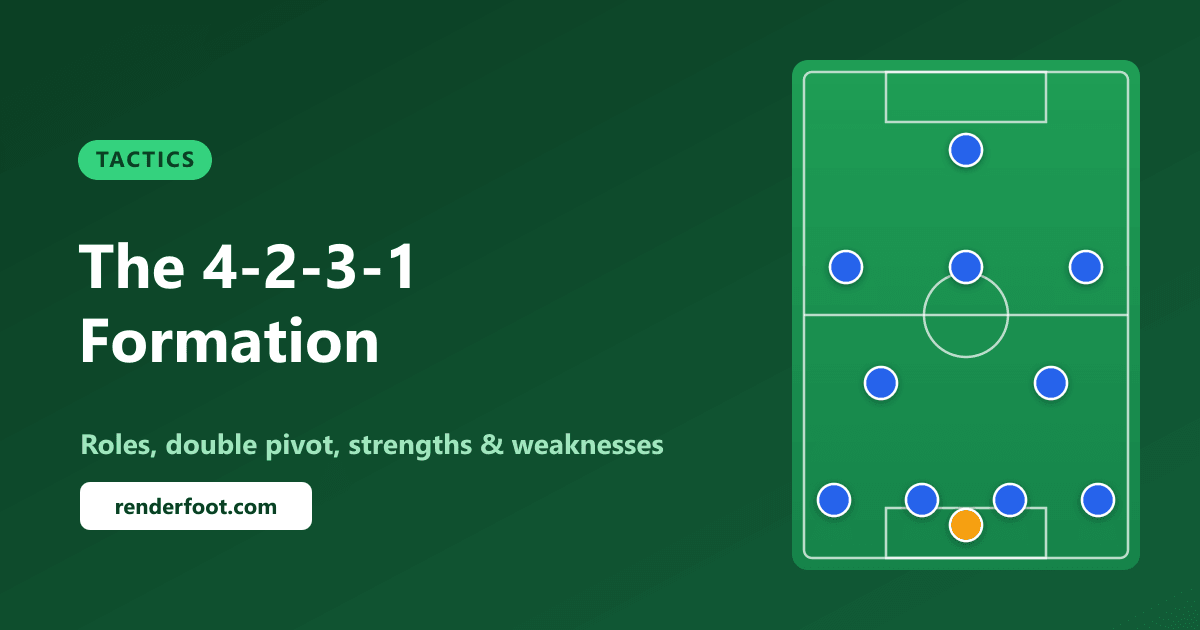
The 4-2-3-1 is a four-line formation made up of a back four, two holding midfielders known as the double pivot, three attacking midfielders (a central number 10 flanked by two wingers), and a lone striker. It's one of the most popular shapes in modern football because it blends defensive solidity with attacking flexibility better than almost any other system.
This guide breaks down exactly how the 4-2-3-1 works: the role of every player, why the double pivot matters, its key strengths and weaknesses, and how it stacks up against the 4-3-3. If you're still learning the basics, start with our best football formations guide.
The structure: four distinct lines
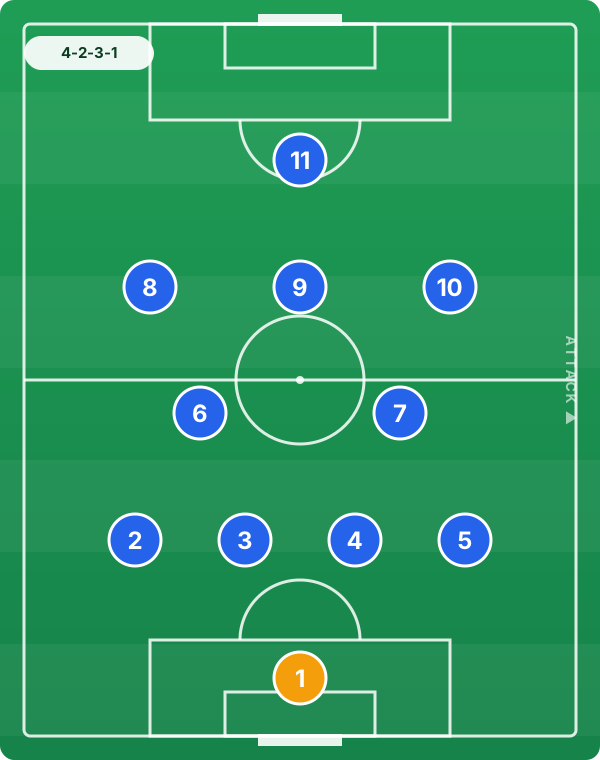
What makes the 4-2-3-1 unique is that it splits the team into four clear lines rather than the traditional three:
- The back four — two centre-backs and two full-backs, the same defensive base as a 4-4-2 or 4-3-3.
- The double pivot — two central midfielders sitting just in front of the defence.
- The attacking three — a central attacking midfielder (the number 10) with a winger on each side.
- The lone striker — a single centre-forward leading the line.
Read from defence to attack, that's 4-2-3-1. Because it fields five midfielders, the formation almost always wins the numbers battle in the centre of the pitch.
Player roles in the 4-2-3-1
The double pivot (the two 6s)
The two holding midfielders are the engine of the system. One often sits deeper as a pure anchor while the other steps forward to help build attacks, but together they screen the back four, win second balls, and protect against counter-attacks. Crucially, having two of them means one can press or push forward while the other covers — the defence is never left unshielded.
What they need: positional discipline, a good passing range, and composure under pressure. Think Sergio Busquets, Toni Kroos, or Casemiro.
The number 10 (attacking midfielder)
The creative hub of the team. Playing in the pocket between the opposition's midfield and defence, the 10 receives between the lines, threads through-balls, and links the midfield to the striker. This is the formation's signature role — it gives a genuine playmaker a dedicated home, which a 4-3-3 doesn't.
What they need: creativity, vision, and quick combination play. Mesut Özil in Germany's 2014 side was the archetype.
The wingers (7 and 11)
The wide attackers stretch the defence and cut inside to shoot or combine with the 10. They carry one of the heaviest workloads in the team: providing attacking width and tracking back to protect their full-backs.
The full-backs
With the wingers often drifting inside, the full-backs supply the width in attack, overlapping high up the pitch. They effectively act as extra wingers going forward and solid defenders in transition — which demands serious stamina.
The lone striker (9)
The centre-forward leads the line, holds the ball up to bring the 10 and wingers into play, and finishes the chances created behind them. A complete striker who can both link play and score suits the role best.
Strengths of the 4-2-3-1
- Defensive solidity. A back four plus two holding midfielders forms a compact block that's very hard to break down through the centre.
- Midfield control. Five midfielders usually outnumber and dominate teams playing a standard midfield three.
- A home for a playmaker. The dedicated number 10 lets a creative star operate in the most dangerous area of the pitch.
- Tactical flexibility. It transitions cleanly into a 4-4-2 or 4-4-1-1 when defending, with the 10 dropping alongside the pivot — making it easy to switch between control and containment. A 4-2-3-1 shape also offers lots of passing angles to play out from the back, which is why it suits possession football (Premier League tactics analysis).
Weaknesses of the 4-2-3-1
- Striker isolation. If the midfield trio doesn't push up quickly, the lone striker gets cut off from the rest of the team.
- Exposed flanks. When both full-backs attack at once, the wide areas are vulnerable to fast switches of play and counter-attacks.
- Winger workload. The wide players must defend as hard as they attack; if they don't track back, the full-backs are left in 2v1 situations.
- Pivot dependency. If an opponent overloads or bypasses the double pivot, the link between defence and attack breaks down.
Why is the 4-2-3-1 so popular?
The 4-2-3-1 rose to prominence in the 2000s and was cemented when Germany won the 2014 FIFA World Cup playing it. Its appeal is simple: it offers the defensive security of two holding midfielders without giving up creativity, and it adapts to almost any opponent. Coaches from Mauricio Pochettino to Hansi Flick have built teams around it, and it remains a default choice at every level from youth football to the Champions League.
4-2-3-1 vs 4-3-3: which is better?
These are the two dominant modern formations, and they're closely related — both use a back four and five midfielders. The difference is how those midfielders are arranged:
- The 4-2-3-1 has two holding midfielders and one advanced playmaker. That makes it more defensively secure and gives a number 10 a clear role.
- The 4-3-3 has one holding midfielder and two box-to-box midfielders, creating a more dynamic, fluid midfield and a stronger collective press.
Choose the 4-2-3-1 for control and balance; choose the 4-3-3 for high-tempo pressing and possession. Many teams switch between the two within a single match — the 4-2-3-1 even becomes a 4-3-3 when the deeper pivot steps up.
Frequently asked questions
What is the 4-2-3-1 formation?
The 4-2-3-1 is a formation with four defenders, two holding midfielders (the double pivot), three attacking midfielders (a number 10 and two wingers), and one striker. It's organised in four lines and is one of the most popular formations in modern football for its balance of defence and attack.
What is a double pivot in the 4-2-3-1?
The double pivot is the pair of central midfielders who sit in front of the back four. They shield the defence, win the ball back, and start attacks. Having two of them means one can press or advance while the other stays back to cover, which gives the formation its defensive stability.
What is the weakness of the 4-2-3-1 formation?
Its main weaknesses are striker isolation (the lone forward can get cut off), exposed flanks when both full-backs push forward, and the heavy defensive workload placed on the wingers. It also depends heavily on the two pivots controlling the centre.
Is the 4-2-3-1 good for possession?
Yes. The shape creates lots of short passing angles and triangles to play out from the back, and its five midfielders help dominate the centre, making it well suited to a possession-based game.
Who plays the number 10 in a 4-2-3-1?
The number 10 is the central attacking midfielder — the team's main creator. They operate between the opposition's midfield and defence to link play and create chances for the striker and wingers. Mesut Özil for Germany's 2014 World Cup-winning side is a classic example.
Build your 4-2-3-1 lineup
The best way to understand the 4-2-3-1 is to set it up yourself. Open the free RenderFoot lineup builder, drop your players into the double pivot, the attacking three and the lone striker, customise the colours and numbers, and export a clean graphic to share with your team — no signup required. For more tactics, explore the full formations guide or learn what every shirt number means in our soccer positions and numbers guide.