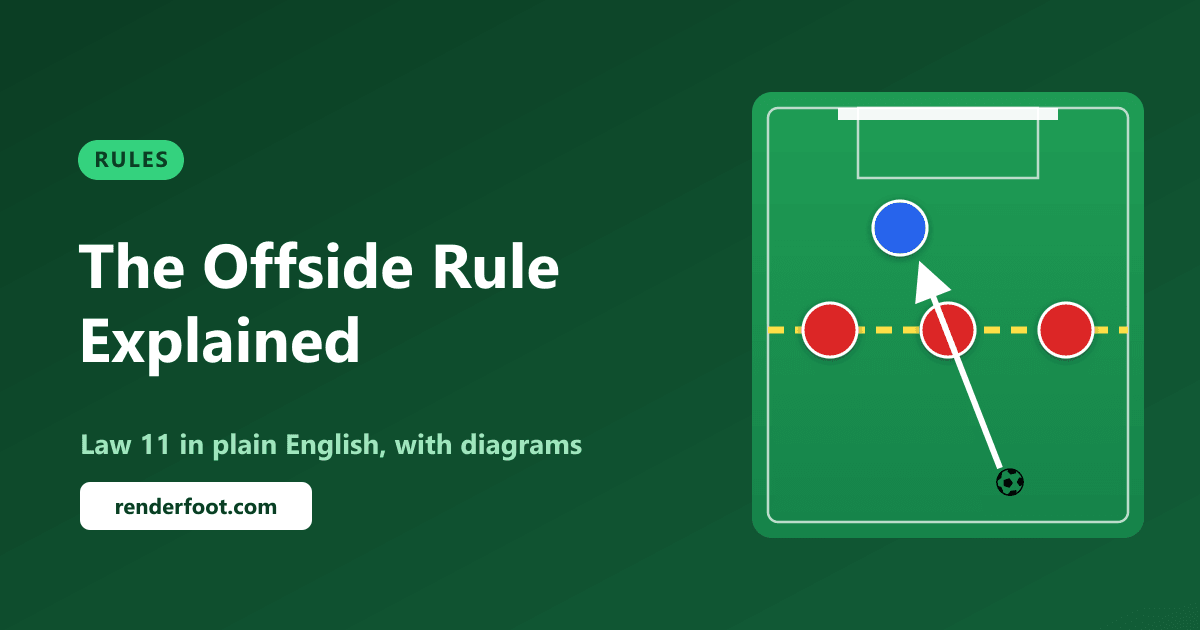
A player is offside if, at the moment a team-mate plays the ball, they are in the opponents' half and any part of their head, body or feet is nearer the opponents' goal line than both the ball and the second-last opponent — and they then get involved in the play. Being in that position is not an offence on its own; the referee only penalises it when the player touches the ball, blocks an opponent, or gains an advantage from it.
That single sentence is the whole of Law 11. Everything that makes offside feel complicated comes from three details inside it: when it is judged, who counts as the second-last opponent, and what counts as being involved. This guide walks through each one with diagrams, and you can drag the players yourself in the simulator below.
What an offside position actually is
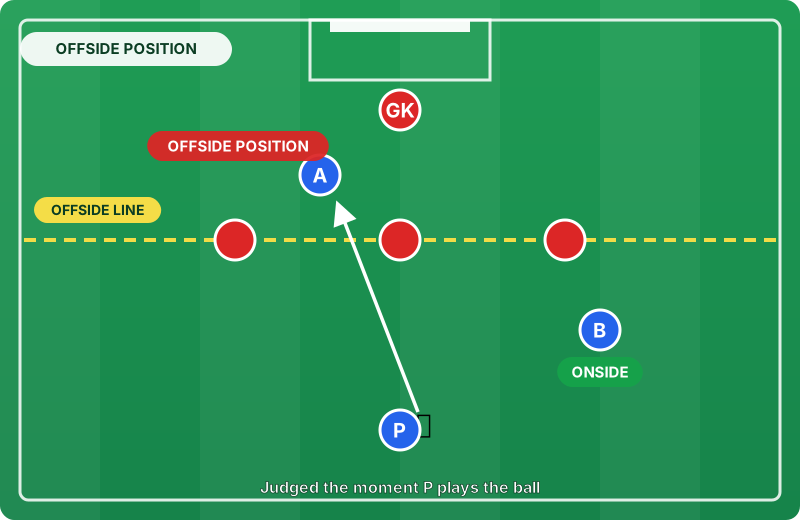
Draw an imaginary line across the pitch through the second-last opponent. In almost every case the last opponent is the goalkeeper, so the second-last is the deepest outfield defender — that defender's line is the offside line.
A player is in an offside position if all three are true:
- They are in the opponents' half (the halfway line itself doesn't count).
- They are nearer the goal line than the ball.
- They are nearer the goal line than the second-last opponent.
Two things are deliberately excluded. Hands and arms don't count — the law measures to "the bottom of the armpit", because you cannot score with your arm. And the position is frozen at the instant the ball is played by the team-mate, not the instant it is received. That is why a striker can look ten yards clear when the ball reaches them and still be perfectly onside.
Level with the last defender is onside
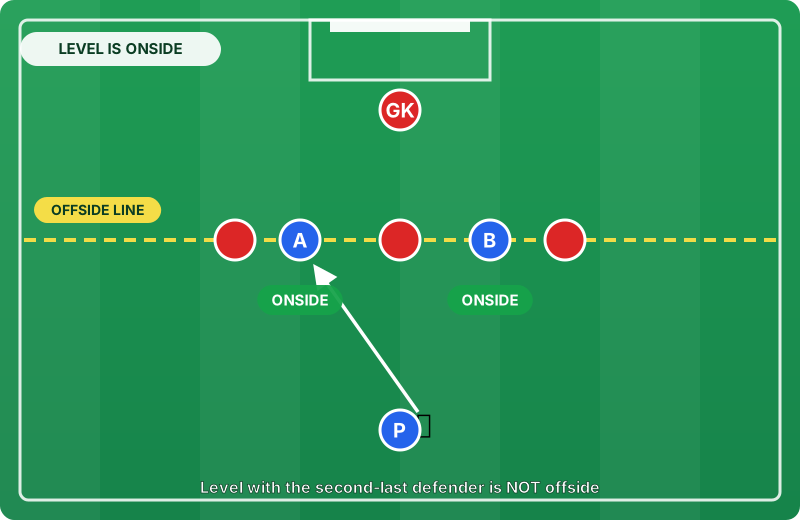
The law says nearer, not level. A player who is exactly level with the second-last opponent — or level with the last two opponents — is onside. The same applies to being level with the ball.
This is where most sideline arguments come from, and it is also why the tightest video-assistant-referee calls take so long: at the top level the difference is often a few centimetres of a shoulder.
Being in an offside position is not an offence
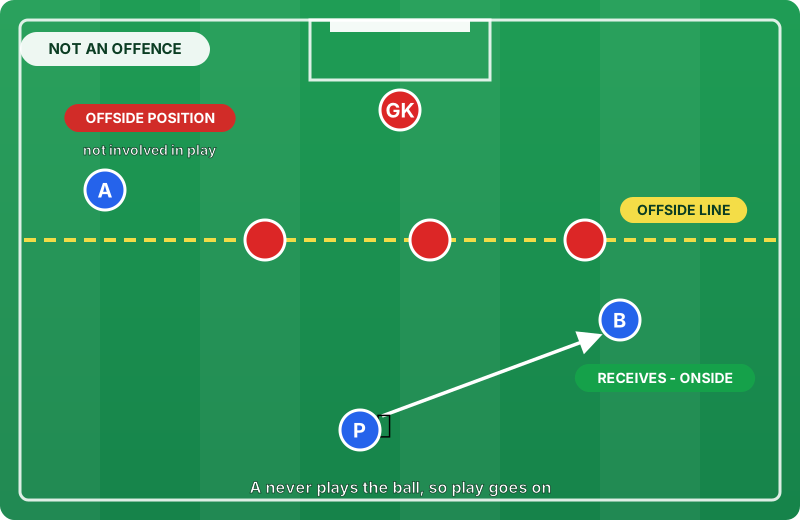
This is the part that trips up new fans, and it answers the common question "can a player be offside without touching the ball?" — yes, but only in a specific way.
A player in an offside position is penalised only when they become involved in active play by:
- Interfering with play — playing or touching a ball passed or touched by a team-mate.
- Interfering with an opponent — blocking their line of vision, challenging them for the ball, or otherwise stopping them playing it.
- Gaining an advantage — playing the ball after it rebounds off the post, crossbar, a match official or an opponent, or after it has been deliberately saved by any opponent.
A winger standing three yards beyond the last defender on the far touchline, doing nothing while the move goes down the other side, has committed no offence. Play goes on.
Try it: the offside simulator
Drag the attacker and the defensive line below — or use the sliders and arrow keys — and watch the verdict flip in real time. The quickest way to feel the rule is to line the attacker up exactly with the last defender and see that it reads ONSIDE.
Timing the run: what actually decides it
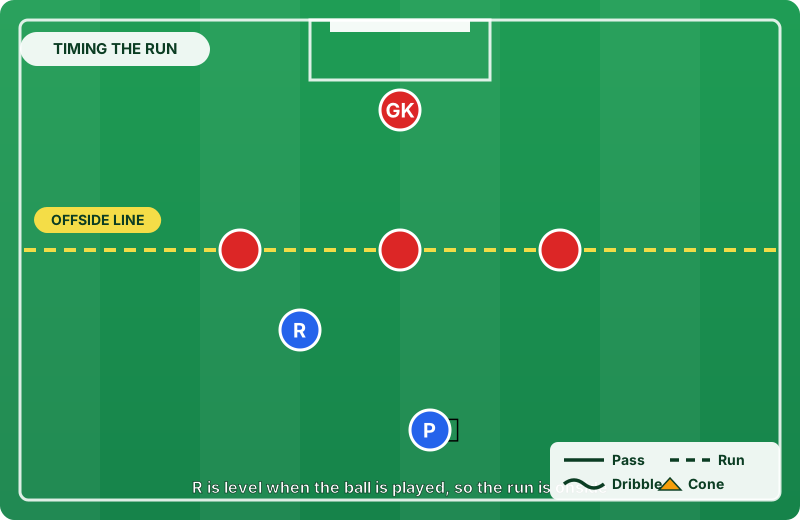
Because offside is judged at the moment the pass is played, a striker's job is to arrive late. Start behind the line, stay level as the passer looks up, and only accelerate once the ball has left their foot. The defender who holds a flat line and the attacker who delays the run are playing the same game from opposite sides.
Coaches drill this as the "stay-and-go": the forward checks his shoulder, holds a half-yard behind the deepest defender, then breaks the moment contact is made with the ball. You can map the line and the runs on the free RenderFoot tactical board to show a squad exactly where to hold.
When you cannot be offside
There are more exceptions than most people realise:
| Situation | Can you be offside? |
|---|---|
| Direct from a throw-in | No |
| Direct from a goal kick | No |
| Direct from a corner kick | No |
| In your own half | No |
| Level with the second-last opponent | No |
| Receiving from an opponent's deliberate play (not a save) | No |
| From a rebound off the post, crossbar or an official | Yes |
| From a deliberate save by any opponent | Yes |
That deliberate-play line matters. If a defender genuinely chooses to play the ball — a header back, an attempted interception, even a deliberate handball — and it falls to a player who was in an offside position, there is no offence. A deflection off a defender who is just reacting, or a save by any opponent, does not reset it.
The punishment
An offside offence is punished with an indirect free kick to the defending team, taken from where the offence occurred — including inside the offending player's own half, if that is where they were when they touched the ball.
Why do Americans say "offsides"?
Because American football uses offsides (with an s) for its own line-of-scrimmage infraction, and the habit carried over. In soccer's own laws the term is always singular: offside. Both are understood everywhere; only one appears in the rulebook.
Has FIFA changed the offside rule?
Not yet. Law 11 as written above is still the law of the game. What exists is a trial: the Canadian Premier League began testing a "daylight" version of offside in April 2026, led by FIFA and approved by The IFAB, in which a player is only offside when there is clear daylight between them and the last defender. It is designed to favour attackers, and it has not been adopted into the Laws.
Separately, semi-automated offside technology — limb tracking that builds the offside line automatically and hands it to the video assistant referee — has been used at FIFA tournaments since 2022. It doesn't change what offside is; it just measures it faster.
Coaching the offside line
For defenders, offside is a weapon rather than a rule to survive. A back line that steps up together compresses the space a team has to defend and pushes opponents thirty yards further from goal. It needs three things:
- One trigger. Usually the moment the ball goes backwards or a passer's head goes down.
- A flat line. One defender who lags plays everybody onside — this is why the second-last opponent matters so much.
- A voice. One player, normally the deepest centre-back, calls the step.
If you're teaching a back four where to hold that line, our guides to defender positions and the best formations for beginners cover the shapes it sits inside.
One important exception for youth coaches: in U.S. Soccer's 7v7 format there is no offside between the halfway line and the build-out line, and there is no offside at all below the 9U age group. Our U10 practice plan shows how that works on the field.
Frequently asked questions
How do you explain the offside rule simply?
You can't stand closer to the opponents' goal than the ball and the second-to-last defender when your team-mate passes to you. If you do, and you get involved in the play, it's offside and the other team gets a free kick.
Can a player be offside without touching the ball?
Yes. If they block a defender or the goalkeeper's line of vision, challenge for the ball, or otherwise stop an opponent playing it, that is interfering with an opponent — no touch required. Simply standing in an offside position while the play happens elsewhere is not an offence.
How do you explain offside to a kid?
Tell them: don't wait behind the last defender for the ball — run onto it after it's kicked. Then walk them through it on the field once, at walking pace, and let them try the simulator above.
Can you be offside from a throw-in?
No. There is no offside offence direct from a throw-in, a goal kick or a corner kick.
Is being level with the defender offside?
No. The law requires you to be nearer the goal line than the second-last opponent. Level with them — or level with the last two opponents — is onside.
Why is offside so confusing?
Because three separate things have to be judged at once: an exact position, the exact instant the ball is played, and whether the player later becomes involved. Each is simple; deciding all three in real time from the touchline is not.
What is the punishment for offside?
An indirect free kick to the defending team, taken from the spot where the offside player got involved in play.
Put it into practice
Offside makes sense the moment you can see it. Use the simulator above until level-with-the-defender stops feeling wrong, then map a defensive line and a set of timed runs on the free RenderFoot tactical board.
For the rest of the laws, start with our complete rules of soccer guide. If a term in this article was new, the soccer terms glossary has it, and the soccer field dimensions guide explains the markings the offside line runs across.
Sources: IFAB Laws of the Game, Law 11 — Offside; The FA, Law 11 — Offside; FIFA: Canadian Premier League daylight offside trial; The IFAB: law changes.